Competence, Operation and Restraint against property, THE TRANSFER OF PROPERTY ACT,1882

SECTION 7: PERSONS COMPETENT TO TRANSFER

  • Here, person must be-
    • Competent to contract , means have:
      • Attained the age of majority,
      • Soundness of mind and
      • Not been disqualification of law.
    • Entitled to property, as
      • Entitlement of transferable property or
      • Authority to dispose of transferable property, not being his own property.
  • Property, transferred by above mentioned people must be-
    • Either, whole or in part,
    • Either absolute or conditional; where conditional :
      • To circumstantial extent and
      • In the manner, which is being allowed and prescribed by any law for the time being in force
  • Based upon, Latin maxim-
    • “Nemo dat quod non habet”, means:
      • No one gives what they do not have, which states that the purchase of a possession from someone who has no ownership right to , it also denies the purchaser any ownership title.

SECTION 8: OPERATION OF TRANSFER

  • Transfer of property leads to, transfer interest from transferor to transferee, which-
    • Transferee is then capable of passing and
    • In the legal incidents thereof.
  • Exception-
    • Any of the different intention:
      • Expressed or
      • Necessarily implied.
  • Legal incidents (above mentioned), under which interest is being transferred from transferor to transferee are-
    • Where, property is land:
      • Easements annexes thereto,
      • Rents, profits accruing after transfer
    • Where, property is a house:
      • Easement annexed thereto,
      • Rent accruing after transfer thereof,
      • Locks, keys, bars, doors, windows and all other things provided for permanent use therewith.
    • Where, property is machine, attached to the earth:
      • Movable parts of the machine.
    • Where, property is a debt or other actionable claim:
      • Security( except, where they are also for other debts or claims not transferred to the transferee)
      • No arrears of interest accrued before property yielding is transferred
    • Where, property is money or other property yielding income:
      • Interest or income thereof accruing after the transfer takes effect.

SECTION 10: CONDITION RESTRAINING ALIENATION

  • Concept-
    • Transfer is void when a transferor transfers a property, subject to conditions or limitations, which lead to absolute restrain.
    • “Absolute Restraint”, means a condition that attempts to take away either totally or substantially the power of alienation, and restraint on alienation is said to be absolute when it totally takes the right of disposal from the transferee.
    • In words of Justice Fry, “from the earliest times, the courts have always learnt against any devise to render an estate inalienable”.
  • Ingredients-
    • Conditions which absolutely restraint the alienation.
    • Partial restrain is valid and enforceable.
    • This section applies only when there is transfer of ownership like:
      • Sale,
      • Gift, and
      • Actionable claim.
    • This section does applies on:
      • Mortgage or
      • Lease.
  • Object-
    • Right of disposal is one of the essential features of ownership, and it is the right of owner.
    • Clarifies that the transfer would not be void but the condition would be.
  • Exceptions-
    • Lease:
      • It applies to permanent or temporary lease.
      • Where, condition is beneficial for lessor or other claiming under him.
    • Married women:
      • To safeguard the right of married women.
      • So that she shall not have power during her marriage to transfer or charge the same or her beneficial interest therein.
  • Excludes: Compromise-

Compromise is outside the preview of section 5, transfer of property. So section 10 does not apply on compromise.

Case 1: Mata Parsad V Nageshar Sahai

Dispute over succeeding the properties of the deceased between his widow and nephew. It was compromise between them that widow shall hold the possession of the property for her life while admitting the title of the nephew but nephew was restrained from transferring the property during the life of the widow.

Case 2: Laxmama V State of Karnataka

Court, held grant by government does not fall within the meaning of section 5 so it can be restraint.

CHAPTER IV: SAFETY (Section 21-41), CHAPTER IV-A: PROVISIONS RELATING TO HAZARDOUS PROCESSES (Section 41A- 41H), THE FACTORY ACT, 1948

CHAPTER IV- SAFETY

SECTION 21: FENCING OF MACHINERY

  • In every factory, specific parts of machinery should be secured by fencing them with safeguards of substantial construction.
  • Duration of fencing- It must be constantly maintained and kept in position while the parts of machinery (hereby fenced), are in motion or in use.
  • Parts being fenced are as follows-
    • Every moving part of prime mover and every flywheel connected to prime mover whether both of them are in the engine house or not.
    • The headrace and tailrace of every waterwheel and water turbine.
    • Any part of stock-bar which projects beyond the head stock of a lathe and
    • Following, being in such position or construction, which is as safe as to every person employed as they would have been if they were securely fenced-
      • Every part of an electric generator, a motor or rotary converter;
      • Every part of transmission machinery; and
      • Every dangerous part of any other machinery.
  • To determine position or construction of any part of machinery, which is as safe to let go fencing, don’t take account on the following-
    • When it is necessary while the part of machinery is in motion to carry out  the following examination (in accordance with subsection 1 of section 22)-
      • lubrication or
      • Other adjusting operations.
    • When, it is necessary while any part of transmission machinery is in such continuous process (which is substantially interfered with by the stoppage of that part of machinery) is examined( in accordance with subsection 1 of section 22) to-
      • mounting or shipping of belts or
      • Doing lubrication or
      • Other adjusting operation.
  • State government prescribe rules to secure the safety of workers, and particular machinery or its relevant part, for-
    • talking necessary precautions or
    • Making exemptions regarding prescribed conditions.

SECTION 22: WORK ON OR NEAR MACHINERY IN MOTION

  • In accordance with section 21, when in any factory it becomes necessary for parts of machinery to be examined whole in motion, result of such examination must be carried out accordingly-
    • For moving part of prime mover and every flywheel connected to prime mover whether both (prime mover or flywheel) of them are in the engine house or not-  It require lubrication or other adjusting operations to be carried out.
    • For headrace or tailrace of every waterwheel and water turbine- It requires mounting or shipping of belts or lubrication or other adjusting operations to be carried out.
  • Specified examination or operation when machine is in motion, should be carried out by-
    • Trained adult mate worker,
    • Wearing tight fitting clothes (supplied by occupier),
    • Who has been recorded in register in this behalf and
    • Who has been furnished with his certificate of appointment.
  • Appropriate aforementioned worker (before mentioned), Will not engage in handling belt at a moving pulley, unless-
    • Belt width is not more than 15 centimetres.
    • Pulley’s purpose is to drive and not merely fly-wheel or balance wheel.
    • Belt’s joint is either laced or flushed with the belt.
    • Belt (including joint and pulley rim) are in good repair.
    • There is reasonable clearance between pulley and any fixed plant or structure.
    • Foothold and handhold (if necessary) provided for operation are secured.
    • A second person is there to securely fix or lash or firmly hold any ladder in use for carrying out any examination or operation.
  • Machinery (or parts), with which workers (aforementioned) are otherwise liable to come in contact, should be securely fenced to prevent such contact, like-
    • Every set screw, bolt and key on any revolving shelf, spindle, wheel or pinion and
    • All spur, worm and other toothed or friction gearing in motion.
  • To protect women or young person form getting injured from any moving part of machinery or any adjacent machinery by exposing them to risk, while-
    • Cleaning, lubricating or adjusting any part of a prime mover or
    • Cleaning, lubricating or adjusting any part of a any transmission machinery or
    • Cleaning, lubricating or adjusting any part of any machinery.
  • State government may by notification in the official gazette, prohibit they cleaning, lubricating or adjusting-
    • By any person,
    • Of specified parts of machinery when those parts are in motion,
    • In any factory class or description of factories.

SECTION 23: EMPLOYMENT OF YOUNG PERSONS ON DANGEROUS MACHINES

  • Young person should not be, required or allowed to work at any relevant machine, unless-
    • He has been fully instructed regarding the dangers arising in relation to the machinery and
    • Precautions are observed and
    • He has been provided with-
      • Sufficient training in work at the machinery or
      • Adequate supervision by a person who has a thorough knowledge of the machine.
  • Above provision of this section is applicable upon-
    • Machinery prescribed by state government and
    • As machinery being of such dangerous character that young person’s ought not to work forgoing requirement are complied with.

SECTION 24: STRIKING GEAR AND DEVICES FOR CUTTING OFF POWER

In every factory-

  •  Suitable striking gear or other efficient mechanical appliance-
    • To be provided, maintained and used to move driving belts to and from fast and loose pulleys, which form part of transmission machinery and
    • To be constructed, paced and maintained as to prevent the belt from creeping back on to the fast pulley.
  • Driving belt should not be allowed to rest or ride upon shafting in motion when not in use.
  • Every factory in every work room it is must to provide and maintain, suitable devices for cutting off power inn emergencies from running machinery-
    • Provided, factories in operation before commencement of this Act, this provision was only applicable to workrooms, in which electricity is used as power.
  • In a factory inadvertently ( unintentionally or accidentally) shift from “off to on ” position should be-
    • Provided to cut- off power
    • Arrangements should be made for locking device in safe position to prevent accidental starting of transmission machinery or other machinery, to which the device is fitted.

SECTION 25: SELF- ACTING MACHINES

  • In a factory traversing part of self acting machinery together with a material carried on by it could be allowed to run over a space under which any person is liable to pass.
  • However, such machinery shall be allowed to traverse both outward and inward shall not be part of machinery; works must be capable for passing under moving part of self- acting machine in connection with their employment.
  • Provided;
    • For machinery installed before the commencement of this Act, which does not comply with the requirements of this section, the chief Inspector may permit continued use of such machinery on conditions ensuring safety, he may think fit to impose.

SECTION 26: CASING OF NEW MACHINERY

  • All power driven machinery, installed in any factory which are being installed after commencement of this Act, should be so-
    • Sunk, encase or otherwise effectively guard-
      • Every set screw, bolt or key
      • Which are on any revolving shaft, spindle, wheel or pinion .
    • Completely encase, unless so safely situated as it would have completely encased –
      • All spur, worm and other toothed or friction gearing
      • Which does not require frequent adjustment while in motion.
  • State government possess power to make rules-
    • Specifying safeguards to be provided further
    • Regarding any dangerous part of any particular machinery or class or description of machines.
  • Punishment, for not compliance with the above mentioned provision of this section-
    • Imprisonment, for term which may extend to 3 months or
    • Fine, which may extend to 500 rupees or
    • Both
  • Punishment is to be granted to those, who used power driven machinery in a factory without compliance of the provision of this section, whoever-
    • Sells or
    • Lets on hire or
    • Agent of seller or hirer (causes or procures to be sold on let on hire).

SECTION 27: PROHIBITION OF EMPLOYMENT OF WOMEN AND CHILDREN NEAR COTTON- OPENERS

  • Employment of woman or child is prohibited, in any part of factory for pressing cotton, in which a cotton- opener is at work.
  • Exception: Women and children may be employed on the feeding- end of the cotton opener, provided, it is been separated from delivery end by-
    • Partition extending to the roof or
    • To such height as the Inspector may specify in writing in any particular case.

SECTION 28: HOISTS AND LIFTS

  • Specifications, in regard to every hoist and lift in every factory-
    • Construction of hoist and lift:
      • Good mechanical construction
      • With sound material
      • Of adequate strength.
    • Maintenance:
      • Thoroughly examine it by a competent person, at least once inn every period of 6 months and
      • Register should be kept, containing prescribed particulars of every such examination.
    • Safety:
      • Maximum safe working load should be plainly marked on every hoist or lift and
      • Limit should not be exceeded, while load is carried thereon.
    • Construction of cage(used for carrying person) of hoists and lifts:
      • Fit gate on each side
      • So that gate could proivide access to landing.
    • Gate:
      • For security, gate should be fitted with interlocking or other efficient device.
      • Gate should not open except, cage is at the landing.
      • Until gate is closed, cage could move.
  • After commencement of this Act, addition requirements regarding hoists and lifts used for carrying persons and installed or reconstructed in a factory-
    • In case, cage is supported by rope or chain, there should be:
      • At least 2 ropes or chain separately connected with the cage and balance weight.
      • Capable with its attachments, of carrying whole weight of cage together with its maximum load.
    • Provision and maintenance of efficient device, capable of supporting cage together with its maximum load in the event of breakage of ropes, chains or attachments.
    • Provision and maintenance of efficient automatic device to prevent cage from over- running.
  • Chief Inspector may permit, factories before the commencement of thus Act, to continue the use of installed hoist or lift-
    • Despite of being complied with specification of hoist and lift in this section.
    • But not without fulfilling conditions, he may think fit to impose to ensure safety.
  • State government in respect of any class or description of hoist or lift-
    • By thinking of it being unreasonable to enforce, specification provision and after commencement requirements of this section.
    • May order, directing that such requirements, shall not apply to such class or description of hoist or lift.
  • Here, any lifting machinery or appliance does not deemed to be hoist or lift unless-
    • It has platform or cage
    • Direction or movement of which is restricted by a guide or guide.

SECTION 29: LIFTING MACHINES, CHAINS,ROPES AND LIFTING TACKLES

  • Every factory has to comply with provisions mentioned in this section, regarding-
    • Every lifting machine (other than a hoist and lift) and
    • Every chain, rope and lifting tackle for the purpose of raising or lowering persons, goods or materials.
  • Specifications, of all parts including working gear, whether fixed or movable of every lifting machine and every chain, rope or lifting tackle-
    • Good construction-
    • with sound material
    • Of adequate strength and
    • Free from defects.,
  • Proper maintenance
  • Thorough examination-
    • By competent person: at least once in every period of 12 months or
    • As per Chef Inspector: Specify such examination in intervals in writing.
    • A register, to be kept containing prescribed particulars of every such examination.
  • Not without purpose of test, lifting machine, chain, rope or lifting tackle should be loaded beyond the safe working load and with-
    • Such load to be plainly marked thereon together with an identification mark and its entry in register or prescribed
    • Otherwise, a table showing safe working loads of every kind and size of lifting machine or chain, rope or lifting tackle in use, should be displayed in prominent positions on the premises.
  • Provision regarding, when a person is employed or working on a near the wheel track of travelling crane-
    • If crane should not have any approach w3ithin 6 meters of the place where such employers may struck by the crane.
  • State government may make relevant rules like-
    • Prescribe requirements to be complied with in addition to those already set out in this section.
    • Provide exemption from complying with all or any of the requirements of this section, if he thinks such compliance is unnecessary or impractical.
  • Explanation: some terms being used herein-
    • ‘lifting machine’ includes-
      • Crane,
      • Crab,
      • Winch,
      • Pulley block,
      • Gin wheel,
      • Transporter or
      • runway
    • ‘lifting tackle”, used in connection with raising or lowering persons, or loads by use of lifting machines, any-
      • Chain,
      • Sling,
      • Rope sling,
      • Hook,
      • Shackle,
      • Swivel,
      • Coupling,
      • Socket,
      • Clamp,
      • Tray or
      • Any similar appliance (while fixed or movable).

SECTION 30: REVOLVING MACHINERY

  • Every factory in which grinding process is carried on, there must be a notice, permanently affixed to or place near each machine, indicating-
    • Maximum safe working peripheral speed of every grin stone or abrasive wheel,
    • Speed of the shaft or spindle upon which the wheel is mounted and
    • Diameter of pulley upon such shaft or spindle, to secure safe working peripheral speed.
  • Speed limit mentioned above, should not be exceeded
  • Effective measures should be taken to ensure that the safe working peripheral speed has not exceeded, for-
    • Revolving vessel,
    • Cage,
    • Basket,
    • Flywheel,
    • Pulley,
    • Disc or
    • Similar appliance driven by power.

SECTION 31: PRESSURE PLANT

  • Any factory,
    • Where any plant or machinery or any part thereof is being operated at a pressure above the atmospheric pressure,
    • Effective measures should be taken to ensure, that the safe working pressure should not exceeded.
  • State government may make rules regarding-
    • Examination and testing of such plant and machinery and
    • Other safety measures, they think necessary in any factory or class or description of factories.
    • Exemption of any relevant part of any plant or machinery from above mentioned conditions in this section.

SECTION 32: FLOOR, STAIRS AND MEANS OF ACCESS

In every factory-

  • All floors, steps, stairs, passages and gangways should be-
    • Of sound construction,
    • Properly maintained and
    • Kept free from obstructions and substances likely to cause persons to step.
    • Provided with substantial handrails, where it is necessary.
  • To every place, at which any person is at any time required to work, safe means of access must be provided and maintained as far as reasonably practicable.
  • When any person, who has to work at a height from where he is likely to full, fencing or any other way should be provided to ensure safety of such person as far as reasonably practicable.

SECTION 33: PITS, SUMS, OPENINGS AND FLOORS, ETC.

  • In every factory, in which there is fixed vessel, sump, tank, pit or opening in the ground or in the floor should be either severely covered or securely fenced, due to its-
    • Depth,
    • Situation,
    • Construction,
    • Content or
  • State government, may make rules to exempt relevant pits, sums or openings in floors from compliance with provision of this section.

SECTION 34: EXCESSIVE WEIGHTS

  • In any factory no person should be employee to lift, carry or move any load so heavy, which could likely cause him injury.
  • State government may make rules for any class or description of factories or in carrying on any specified process, in regard to specifying, the maximum weights which could be lifted, carried or moved by-
    • Adult men,
    • Adult women,
    • Adolescents and
    • Children.

SECTION 35: PROTECTION OF EYES

  • This section involves, any of those factories which carry out such manufacturing process, which may involve risk of injury to the eyes by-
    • Particles or fragments thrown off in the course of process or
    • Being exposed to excessive light
  • State Government may through rules-
    • For the protection of persons-
    • Employed on the process or
    • In immediate vicinity of the process.
  • By providing them with-
    • Effective screens or
    • Suitable goggles.

SECTION 36: PRECAUTIONS AGAINST DANGEROUS FUMES, GASES etc.

In any factory,

  • No person is required or allowed to-
    • Enter any chamber, tank, vat, pit, pipe, flue or other confined space
    • Where, any gas, fume, vapors or dust is likely to be present, to such an extent to involve risk to that person.
    • Unless:
      • There is any provision of manhole of adequate size or other effective means of egress.
      • All practicable measures have been taken to remove gas, fume, vapors or dust to bring its level within permissible limits and to prevent it’s any ingress.
  • Exceptions to the provision of this section-
    • If, a written certificate mentioning a test of the space is being reasonably free from dangerous gas, fume, vapors or dust by a competent person has to be given.
    • If such person is wearing-
      • Suitable breathing apparatus and
      • Belt securely attached to rope, the free end of which is told by a person outside the confined space.

SECTION 36 A: PRECAUTIONS REGARDING THE USE OF PORTABLE ELECTRIC LIGHT

  • In any factory-
    • Inside any confined place (chamber, tank, vat, pit, pipe, flue or any other)-
      • No portable electric light or any electric appliance is allowed
      • Unless, its voltage does not exceed 24 volts.
  • If the gas, fume or dust on the confined place is inflammable-
    • No lamp or light is permitted
    • Unless it is flame proof.

SECTION 37: EXPLOSIVE OR INFLAMMABLE DUST, GAS, ect.

  • In any factory, with any manufacturing process, producing dust, gas, fume, or vapor of character, with could likely to explode to ignition. To prevent the explosion, preventive measures to be taken are-
    • Effective enclosure of plant or machinery used in the process,
    • Removal or prevention of accumulation of such dust, gas, fume or vapors.
    • Exclusion or effective enclosure of all possible sources of ignition
  • In case the relevant plant or machinery is not constructed tom withstand the probable pressure caused by the aforesaid explosive, all practicable measures should be taken to restrict spread and effects of the explosion by providing plant and machinery with-
    • Chokes,
    • Baffles,
    • Vents or
    • Other effective appliances
  • Any part of plant or machinery (containing any explosive or inflammable gas or vapors which is under or other means, before fastening the loosen opening of the joint of any pipe connected with relevant part.
    • Any flow of gas or vapor into the part of any such pipe is effectively stopped by stop value or other means, before fastening the loosen opening of the joint of any pipe connected with relevant part.
    • All practicable measures are taken to prevent any explosive or inflammable gas, vapors in the part or pipe to atmospheric pressure, before aforesaid fastening is removed.
    • Effective measures should be taken to prevent any explosive or inflammable gas or vapor from entering the part of pipe, where aforesaid fastenings has been loosen or removed, until fastening has been secured or securely replaced.
    • Exception- this provision is not applicable upon plants or machinery, installed in open air.
  • Any plant, tank, vessel containing any explosive or inflammable substance in a factory which is subject to welding, brazing, soldering or cutting operation with heat appliances. To prevent any risk of ignition-
    • Adequate measures should be taken to remove such substance or render it non- explosives or non- in-flammables and
    • Such substances should not be allowed to enter such plant, tank or vessel, after any such operation until the metal has cooled sufficiently.
  • State government through making rules, may exempt-
    • Subject to such prescribed conditions
    • Any factory or class or description of factories from complying with all or any of the provision of this section.

SECTION 38: PRECAUTIONS IN CASE OF FIRE

  • In every factory, to prevent outbreak of fire and its spread (both internally or externally), all practicable measures should be taken by providing and maintaining-
    • Safe means of escape for all persons in the event of a fire and
    • Necessary equipment and facilities for extinguishing fire.
  • In every factory, effective measures should be taken to ensure that-
    • All workers are familiar with the means of escape in case of fire and
    • All workers have been adequately trained in the routine to be followed in such case.
  • State government make rules, regarding required measures which are to be adopted to give effect to the earlier provisions of this section in any factory or class or description of factories.
  • Irrespective of the earlier provision relating to-Safe means of escapoe4 for all persons in the event of fire and
    • All workers are familiar to means of escape and trained in the routine,.
    • Chief Inspector, by order in writing may require some additional measures as he may consider reasonable and necessary to be provided in factory before specified date in the order, in regard to-
      • Nature of the work carried on in any factory or
      • Construction of such factory or
      • Special risk of life or safety or
      • Any other circumstances.

SECTION 39: POWER TO REQUIRE SPECIFICATIONS OF DEFECTIVE PARTS OR TESTS OF STABILITY

Inspector’s power, in case-

  • If the condition of any building or part of a building or any part of the ways, machinery or plant in factory appears to the Inspector, dangerous to human life or safety.
  • Inspector may through written order require the occupier or manager or both, to furnish him before a specified with-
    • Such drawing, specifications and other particulars as may be necessary to determine whether such building, ways, machinery or plant can be used with safety or
    • To carry out such test, as specified in the order and to inform the Inspector of the results thereof.

SECTION 40: SAFETY OF BUILDINGS AND MACHINERY

Mentioning conditions, appearing to the Inspector, regarding building or part of a building or any part of the ways, machinery or plant in a factory, unsafe to human life and safety, to which Inspector through written order direct occupier or manager or both to follow up, as-

  • Situation: if condition is dangerous to human life or safety.
    • Remedy: measures, in Inspector’s opinion should be adopted and requiring occupier or manager or both to carry it out before specified date.
  • Situation: if condition involves imminent danger to human life.
    • Remedy: prohibition of its use, until it has been properly repaired or altered.

SECTION 40A: MAINTENANCE OF BUILDINGS

  • In case, it appears to the Inspector that, any building or part of building in a factory is in such a state of disrepair as is likely to lead to conditions detrimental to the health and welfare of the workers.
  • As a resolution, Inspector may serve on the occupier or manager or both of the factory on written order specifying-
    • The measures, which in his opinion should be taken and
    • Required to be carried out before such date as is specified in the order.

SECTION 40B: SAFETY OFFICERS

  • If state government requires (by notification in the official gazette) the employment of specified number of safety officers, then occupier should, if that factory is wherein-
    • One thousand or more workers are ordinarily employed or
    • Any manufacturing process or operation being carried out, in the opinion of state government involves any-
    • Risk of bodily injury or
    • Poisoning or
    • Disease or
    • Any other health hazard to employed persons of the factory.
  • State government prescribes, safety officer’s-
    • Duties
    • Qualifications
    • Conditions of services.

SECTION 41: POWER TO MAKE RULE TO SUPPLEMENT THIS CHAPTER

State government may make rules as it deems necessary-

  • Regarding provisions in any factory or in any class or description of factories,
  • Of such further devices and measures,
  • For securing the safety of persons employed therein.

CHAPTER IVA – PROVISIONS RELATING TO HAZARDOUS PROCESSES

SECTION 41A: CONSTITUTION OF SITE APPRAISAL COMMITTEES

  • State government may appoint a site appraisal committee, for the purpose of-
    • Adjusting it to consider permission grant application for initial location of factory involving hazardous process or
    • For expansion of any such factory.
  • Site Appraisal Committee, must consist of-
    • The Chief Inspector of the state who shall be its chairman
    • A representative of the Central; Board for the prevention and Control of Water Pollution appointed by the Central Government under section 3 of the Water (prevention and Control of Pollution) Act, 1974 (6 of 1974).
    • A representative of Central Board for the Prevention and Control of Air Pollution referred to in section 3 of the Air (Prevention and Control of Pollution) Act, 1981 (14 of 1981)
    • A representative of the State Board appointed under section 4 of the Water (Prevention and Control of Pollution) Act, 1974 (6 of 1974).
    • A representative of the State Board for the Prevention and Control of Air Pollution referred to in section 5 of the Air (Prevention and Control of Pollution) Act, 1981 (14 of 1981).
    • A representative of the Department of Environment in the state.
    • A representative of the Meteorological Department of the Government of India.
    • An expert in the field of occupational health and
    • A representative of the Town Planning Department of the State Government, and not more than 5 other members who may be co- opted by the State Government who shall be-
      • A scientist having specialized knowledge of the hazardous process which will be involved in the factory,
      • A representative of the local authority within whose jurisdiction the factory is to be established and
      • Not more than 3 other persons as deemed fit by the State Government.
  • Site Appraisal Committee’s working-
    • Examine on application for the establishment of a factory involving hazardous process
    • Recommends to the State Government within a period of 90 days of receipt of such applications in the prescribed form.
  • The State Government shall co- opt, a representative nominated by Central Government, as a member of the Site Appraisal Committee, where:
    • Any process related to a factory owned or controlled by the Central; Government or
    • Any process related to a corporation or av company owned or controlled by the Central Government.
  • Site Appraisal Committee, have power to-
    • Call for any information from the person making an application for establishment or expansion of a factory involving a hazardous process.
  • The Central Board or the State Board established under Water (Prevention and Control of Pollution) Act, 1974 (6 of 1974) and the Air (Prevention and Control of Pollution) Act, 1981 (14 of 1981`), approval; is not necessary for an applicant, where-
    • State Government has granted approval to an application for the establishment or expansion of a factory involve hazardous process.

SECTION 41B: COMPULSORY DISCLOSURE OF INFORMATION BY THE OCCUPIER

  • The occupier of every factory, involving a hazardous process shall disclose (in prescribed manner) danger which-
    • Includes-
      • Health hazards
      • Measures to overcome such hazards.
    • Arise from exposure to or handling of material or substances, in –
      • Manufacture,
      • Transportation,
      • Storage and
      • Other processes.
    • To the –
      • Workers employed in the factory
      • Chief Inspector
      • Local authority within whose jurisdiction the factory is situated and
      • General public in the vicinity.
  • Information regarding, wastes and the manner of its disposal, furnished under the above provisions, should include accurate information of-
    • Quantity,
    • Specification,
    • Other characteristics.
  • The occupier of the factory, involving hazardous process, at the time of registration-
    • Lays down, detailed policy with respect of health and safety of the workers employed therein and
    • Intimate such policy to the Chief Inspector and the local authority and
    • Thereafter, at intervals (may prescribed) inform the Chief Inspector and the local authority of any change made in the said policy.
  • In case, an accident taking place in the factory, every occupier with the approval of the Chief Inspector shall-
    • Draw up the required safety measures for his factory, through-
      • An onsite emergency plan and
      • Detailed disaster control measures.
    • Make, the required safety measures known to-
      • The workers employed therein and
      • The general public living in the vicinity of the factory.
  • Every occupier should inform the Chief Inspector regarding the nature and details of the process-
    • Within a period of 30 days of the commencement of the Act, if such factory engaged in hazardous process already exists on the commencement of the Factory (Amendment )Act, 1987 (2 of 1987).
    • Within a period of 30 days before the commencement of such process, if such factory proposes to engage in hazardous process at any time after commencement of the Act.
  • If factories fail to comply with informing the Chief Inspector regarding nature and the details of the process, in prescribed manner-
    • Inspire of penalizing,
    • License granted to such factory under section 6 of the Act, will liable to be cancelled by the occupier of the Factory.
  • Handling hazardous substances inside and outside factory premises-
    • Inside:
      • Measures for handling, usage, transportation and storage of hazardous substances.
      • Display the measures to the workers.
    • Outside:
      • Disposal of such substances.
      • Publicize those measures to the general public living in the vicinity.

SECTION 41C: SPECIFIC RESPONSIBILITY OF THE OCCUPIER IN RELATION TO HAZARDOUS PROCESS

  • Maintain, accurate and up to date health records or medical records-
    • Of workers, who are exposed to any chemical toxic or any other harmful substances.
    • Harmful substances, which are manufactured, stored, handled is transported and
    • Mentioned record must be accessible to workers, who are subject the relevant substances,
  • Appoint persons who, if any question arises-
    • Possess qualification and experience, in handling hazardous substances,
    • Competent to supervise such handling within the factory and
    • Provide the necessary facilities at the working place, for the protection of workers, in the prescribed manner.
  • Provide, medical examination of every worker-
    • Before, such worker is assigned to a job involving, handling or working with hazardous substances.
    • While continuing and after he has ceased to work in such job, at intervals not exceeding 12 months in prescribed manner.

SECTION 41D: POWER OF CENTRAL GOVERNMENT TO APPOINT INQUIRY COMMITTEE

  • Central Government, may appoint an Inquiry Committee, with regard to-
    • Events:
      • When, extraordinary situations occur in factory engaged in hazardous process.
    • Purpose:
      • To find out the causes of a failure or negligence, in the adoption of any measures or standards prescribed for the affected or likely to be affected health and safety of-
        • The workers employed in the factory
        • The general public.
  • Inquiry committee consists of-
    • A chairman and
    • 2 other members.

(Terms of the committee and the tenure of office of its members are determined by the Central Government).

  • Inquiry committee’s recommendation should be advisory in nature.

SECTION 41E: EMERGENCY STANDARDS

  • Who will direct whom, to lay down emergency standards and when?
    • Situations, satisfying Central Government that-
      • No standards of safety have been prescribed regarding hazardous process or class of hazardous processes or
      • The standards so prescribed are inadequate.
    • To lay down emergency standards for enforcement of standards, Central Government may direct-
      • The Director General of Factory Advice Service and Labor Institutes or
      • Any institution specialized in relevant matter of safety standards in hazardous processes.
  • Emergency standards mentioned in above provisions of this section, will prevail-
    • Enforceable, having same effect as if they have been incorporated I this Act’s rules.
    • Until, the relevant hazardous process or class of hazardous process incorporate, the rules made under this Act.

SECTION 41F: PERMISSIBLE LIMITS OF EXPOSURE OF CHEMICAL AND TOXIC SUBSTANCES

  • Second Schedule indicates-
    • The maximum permissible threshold limit , value of exposure of chemical and toxic substances inj manufacturing processes (whether hazardous or otherwise) in any factory.
  • At any time, when specialized institutions or experts in the field scientifically proves, that the existing threshold limit value is unsuitable-
    • Central Government, giving effect to any such proof make suitable changes in the said schedules.

SECTION 41G: WORKERS PARTICIPATION IN SAFETY MANAGEMENT

  • Safety Committee is set by the occupier, in every factory-
    • Where hazardous process is under taken or
    • Where hazardous substances are used or handled
  • Safety Committee consists of-
    • Equal number of representatives of workers and management.
  • Purpose to set up Safety Committee-
    • To promote cooperation between the workers and the management, in maintaining proper safety and health at work and
    • The measures taken in that behalf, to review periodically.
  • Exception-
    • The State Government may exempt the occupier of any factory or class of factories from setting up such committee in writing and for reasons to be recorded.
  • Safety Committee’s, relevant specifications should be as may be prescribed, like-
    • The composition
    • The tenure of office of its members.
    • Member’s rights and duties.

SECTION 41H: RIGHT OF WORKERS TO WARN ABOUT IMMINENT DANGER

  • In case, employed workers-
    • Of any factory engaged in a hazardous process and
    • On reasonable ground, have apprehension that there is a likelihood of imminent danger to their lives, or health, due to any accident.
  • Those above mentioned employees may bring the same apprehension to the notice of the –
    • Occupier,
    • Agent ,
    • Manager or
    • Any other person, concerned in charge of factory or process or
    • The safety committee, through their representatives and
    • Inspector.
  • Duty of such occupier, agent, manager or the person in charge of the factory or process to-
    • Step 1: get satisfied regarding the existence of such eminent danger.
    • Step 2: take immediate remedial action.
    • Step 3: send a report forthwith if the action.
  • In case, the relevant occupier, agent, manager or the person in charge, is not satisfied regarding the existence of such imminent danger, they should-
    • Nevertheless, refer the matter forthwith to the nearest Inspector, whose decision on the question of the existence of such imminent danger should be the final.

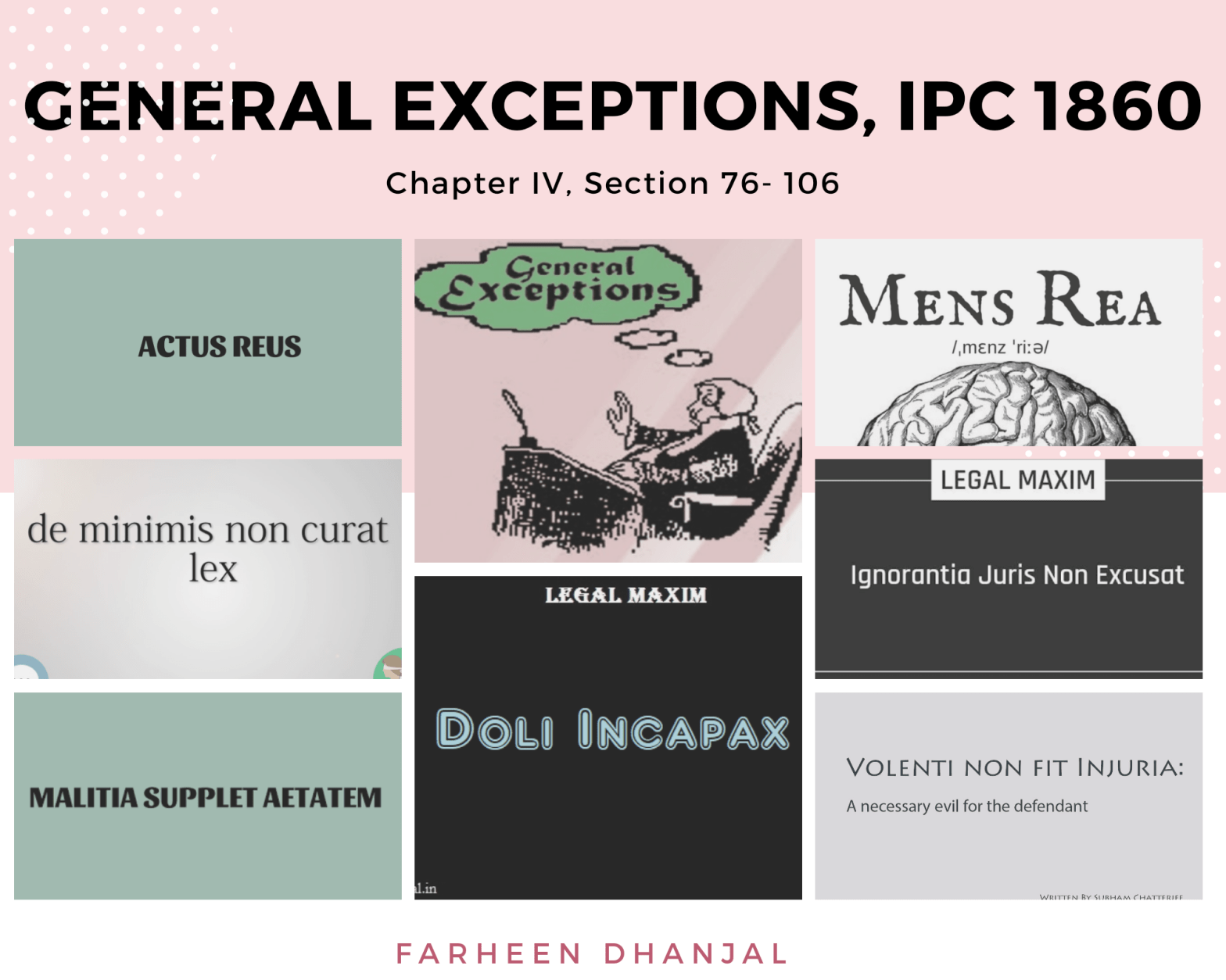
GENERAL EXCEPTIONS (chapter IV)- Section 76- 106, Indian Penal Code ,1860

INTRODUCTION

Criminal Liability has been defined as being responsible for criminal act. It is established principle of criminal law that no one should be convicted or held liable for a crime unless some measure of subjective fault can be attributed to him. Sin que non (essential condition), to the commission of the offense, else absence of these may lead to an acquittal-

  • Actus reus (active performance) and
  • Mens rea (guilty intention).

The criminal law covers various punishments which vary from case to case. But it is not always necessary that a person gets punishment for a crime which he or she had committed. The Indian Penal Code, 1860 recognized defenses in Chapter IV under “General Exceptions” in section 76- 106 covers these defenses which are based on the presumption that a person is not liable for the crime committed. These defenses depend upon:

  • Circumstances prevailing at the point of time,
  • Mena rea(guilty mind) and
  • Reasonability of action of the accused.

SECTION 6, IPC 1860:

Subject to the exceptions inculcated in the chapter titled “General Exceptions” are-

  • Every definition,
  • Every penal provision and
  • Illustration of every definition and penal provision.

OBJECTIVES OF GENERAL EXCEPTION:

  • Exceptional circumstances in which an individual can escape liability.
  • Making Code construction simpler by removing the repetition of criminal exceptions.

ONUS OF PROOF:

Pre- Evidence Act, 1872-

Prosecution had to prove that the case does not fall under any exception, and was beyond reasonable doubt against the accused.

Post- Evidence Act, 1872-

Exceptions, as per section 105, Evidence Act, 1872, a claimant has to prove the existence of general exception in crimes.

CATEGORIES OF GENERAL EXCEPTIONS:

General exceptions are divided into 2 categories-

  • Excusable general exceptions and
  • Justifiable general exceptions

EXCUSABLE GENERAL EXCEPTIONS-

  • In which though the person had caused harm, yet the person should be excused because he cannot be blamed for the act.
  • Situations, covering this phenomenon-
    • Mistake (section 76 and 79),
    • Accident (section 81),
    • Infancy (section 82 and 83),
    • Insanity (section 84),
    • Intoxication (section 85 and 86).

JUSTIFIABLE GENERAL EXCEPTIONS-

  • In which act would have been wrongful under which the act was committed makes it tolerable and acceptable.
  • Situations, covered this phenomenon-
    • Judicial action (section 77 and 78),
    • Consent (section 87- 92),
    • Communication (section 93),
    • Duress (section 94),
    • Trifles (section 95) and
    • Private defense (section 96- 106).

SYNOPSIS OF GENERAL EXCEPTIONS:

Any act mentioned below, is general exception to any criminal liability in existence-

  • Person bound by law to do such certain.
  • Judge, acting judicially.
  • Committed pursuant to an order or a judgment of a Court.
  • Person justified, or believed himself justified, by law.
  • Caused by an accident.
  • Caused to harm done without criminal intent to prevent other harm.
  • Committed by child less than 7 year.
  • Committed by a child above age 7 years and under 12 years, but of immature understanding.
  • Committed by a person of unsound mind.
  • Committed by an intoxicated person and partially exempted.
  • Which is not known to be likely to cause death or grievous hurt done by consent of the sufferer.
  • Not intended to cause death done by consent.
  • Communication made in good faith to a person for his benefit.
  • Done under threat of death.
  • Causing slight harm.
  • Done under private defense.

EXCUSABLE GENERAL EXCEPTION:

MISTAKE (section 76 and 77)

  • If the state of things as claimed is actually true, it would justify the act done.
  • Mistake must be reasonable.
  • To avail this defense mistake should relate to mistake of fact not mistake of law.

 IN GOOD FAITH:

  • Its been defined in section 52, Indian Penal Code, 1860, applicable here.
  • Done with due care and attention.
  • Question is considered with reference to the position of the accused and circumstances under which he acted.

TYPES OF MISTAKES-

  • Mistake of fact
    • bound by law[sec. 76],
    • justified by law[sec. 79]) and
  • Mistake of law.

MISTAKE OF FACT

Latin maxim: ‘Ignorantia facit doth excusat’- mistake of fact is excusable.

Here, act would be considered innocent mistake if-

  • Honest,
  • Reasonable belief and
  • True circumstance.

MISTAKE OF LAW

Latin maxim: ‘Ignorantia juris non excusat’- mistake of law is not excused.

Here, an act would be considered obligatory mistake-

  • Legal presumption, everyone knows te law of the land.
  • Untrue as a matter of fact.
  • Needed for the purpose of expediency of law.
  • Applicable even for recent statute.
  • Not necessary to publish a law.

SECTION 76- ACT DONE BY PERSON BOUND, OR BY MISTAKE OF FACT BELIEVING HIMSELF BOUND, BY LAW:

An act, would no longer be an offence, if the person committing it, has committed it in –

  • Mistake (of fact, not of law) and
  • Good faith (considering himself to be bound by law to do it)

Illustration:

  • Soldier, firing at mob on orders given by his superior officer.
  • Officer of the Court of Justice, arrested someone on the order of the court, but after enquiry found that someone to be not the one, who would have been actually arrested.

SECTION 79: ACT DONE BY A PERSON JUSTIFIED, OR BY MISTAKE OF FACT BELIEVING HIMSELF, JUSTIFIED, BY LAW

An act, would no longer be an offence, if its been committed by someone, who is-

  • Mistaken (of fact not of law) and
  • In good faith (believes him to be justified by law)

Illustration;

A sees B, committing a murder, seizes B in (exercising his right of apprehending murderers) order to bring B before proper authorities, who later on found to be acting in self-defense.

Cases1: Chirangi V State of Nagpur (1952)

  • Chirangi killed his own son my mistake thinking he was a tiger.
  • He was suffering from bilateral cataract.
  • Based upon evidence, he had abscess in his leg which would have produced a temperature which might have caused a temporary delirium. This could cause a secondary delusion affecting his vision.
  • He was held mistaken and thus acquitted.

Case2: Waryam Singh V Emperor (1962)

  • The accused mistook a human being as a ghost and killed him.
  • He was not held liable under section 302, 304 0r 304A.
  • Divisional Bench made it clear that ‘mens rea’ or intention to do wrong or to commit an offence did not exist and object of culpable homicide could only be a living human being.

Case3: Kiran Bedi and Ors. V Committee of Inquiry (1989)

  • Petitioner refused to be deposed (testify or swear) to the beginning of the inquiry as she believed that she could depose only at the end of the inquiry.
  • As the respondent i.e. the commission has not followed its own rule (by denying the treatment of the case under section- 8B of the Committee of Inquiry Act.) and has directed a wrong complaint under section 178, IPC, 1860 against the petitioners.
  • It’s a unique judgment were, ‘good reputation’ is considered an element of personal security and something that is protected by the constitution, equally with the life, property and liberty.
  • So, Judgment was bases upon section 79, IPC as there was ignorance (mistake) of law by the committee.

ACCIDENT (Section 80)

This exception excludes a person from criminal liability where although a person act, such act was devoid of an intention.

ABSENCE OF CRIMINAL INTENTION

  • ‘Criminal intention”- Purpose or design of doing an act forbidden by criminal act without just cause or excuse.
  • Act which are criminal but without the criminal intent, lacking mens rea are not penalized.

SECTION 80: ACCIDENT IN DOING A LAWFUL ACT

  • An act, would obviously not be an offence if-
    • Is itself lawful,
    • Committed in lawful manner,
    • With proper care and caution.
  • Despite of fulfilling above conditions, an act could not be an offence if done by-
    • Accident or misfortune and
    • Without criminal intention or knowledge.

Case: State Government V Rangaswami (1952)

  • An accused, who on a dark night in a cremation ground believed a man to be a ghost and inflicted injuries which cause death, was liable under section 304A, IPC, 1860.
  • Divisional Bench pointed out that the accused had no reason to think that a human being would arrive on the scene at such time and place.
  • Accused was acquitted on the ground of good faith.

INFANCY (Section 82 and 83)

When the child has attained maturity of understanding that he ought not o perform such an act. So, infancy is subject to exception of criminal liability.

LEGAL PRESUMPTIONS

Sec 82- Doli Incapax: A child has no discretion to distinguish right from wrong, thus criminal intention does not arise.

Example- if a child is of 7 years, pressed the trigger of the gun and caused the death of his father, and then the child will not be liable.

Sec. 83- Malitia Supplet Oetatem: Malice supplies age. If proven to have sufficient maturity of understanding, liability arises.

  • Example- if a child is of 10 years, killed his father with a gun in the shadow of immaturity, he will be liable if he has not attained maturity.

SECTION 82: ACT OF A CHILD UNDER SEVEN YEARS OF AGE

An act would no longer be an offence, if committed by a child, who is under seven years of age.

SECTION 83: ACT OF A CHILD ABOVE SEVEN AND UNDER TWELVE OF IMMATURE UNDERSTANDING

An act would not be an offence, if committed by a child, who-

  • Is above seven years of age and under twelve years and
  • Has not attained sufficient maturity of understanding, to judge the nature and consequences of his conduct on the occasion.

Case: Krishna Bhagwan V State of Bihar (1991)

  • A child stole a necklace and immediately resold it.
  • His immediate act of reselling it, showed that he has attained maturity of understanding.
  • Patna High Court upheld that if a child, who is accused of an offence during the trial, has attained the age 7 years or at the time of decision attained 7years of age. He will be convicted if he has the understanding and knowledge of the offence committed by him.

INSANITY (Section 84)

Person with unsound mind at the time of commission of offense, the person was incapable of knowing the nature of his acts and that his action was wrong or contrary to law, is suitable to avail the exception of insanity under this general exception.

TEST OF INSANITY-

  • As the time of commission of offence
  • State of mind before and after
  • Only organic and natural incapability, not uncontrollable impulses, weak intellect or eccentric behavior.

SECTION 84: ACT OF A PERSON OF UNSOUND MIND

An act would no longer be an offence, if the person committing it is of:

  • Unsound mind and
  • Incapable of knowing the nature (wrong or contrary) to law.

Case1: McNaughton case (1843) [locus classicus]

  • Where, accused killed secretary of the British Prime Minister in belief that, the Prime Minister was conspiring against him.
  • He was acquitted of the charge by reason of insanity.
  • This rule created presumption of sanity unless rebutted by the defense.

Case2: Madhukar G. Nigade V State of Maharashtra (2006)

Court held that the benefit of section 84 is that, at the time when the offense was committed, the accused was of-

  • Unsound mind and
  • unable to understand the consequences of his actions.

Case3: Ahmed V King (1949)

  • Accused killed his son by thrusting a knife in his throat under the delusion and in pursuance of a command by someone in paradise, give in his dream.
  • Accused was not held liable, availed the benefit of this exception.

INTOXICATION (Section 85 and 86)

Intoxication is the condition of having physical or mental control markedly diminished by the effects of alcohol or drug, and an abnormal state that is essentially a poisoning. Represented by sections 85 and 86. Main difference between them are in former accused is to be intoxicated involuntarily, in later its presumed in his knowledge until proved otherwise.

Sec. 85- An act performed without the knowledge or against the will of a person, who has is incapable of judgment due to being intoxicated.

Example- A drunk alcohol given by his friend thinking it to be a cold drink. He became intoxicated and hit a person on driving his car back home. He will not be liable as alcohol was administered to him without his will and knowledge.

Sec. 86- Offence requiring intent or knowledge, committed by an intoxicated person. It is presumed, that accused has been intoxicated knowingly unless he proves to be intoxicated without his knowledge or against his will.

Example- A person intoxicated stabs another person under influence of alcohol which was administered to him in the party against his knowledge or will, will not be liable. But if that person had stabbed that person under voluntary intoxication, then he will be liable.

SECTION 85: ACT OF A PERSON INCAPABLE OF JUDGEMENT BY REASON OF INTOXICATION CAUSED AGAINST HIS WILL

An act would not be an offence if;

  • Person performing it, is intoxicated (making him incapable of knowing the nature of the act, that what is he doing is either wrong or contrary to law) and
  • Administration of intoxication is-
    • Without his knowledge or
    • Against his will.

SECTION 86: OFFENCE REQUIRING A PARTICULAR INTENT OR KNOWLEDGE COMMITTED BY ONE WHO IS INTOXICATED

  • An act would be an offence, if carried out by an intoxicated person with a particular knowledge or intent.
  • Such intoxicated would be liable to be dealt with, as if he had performed such act while not been intoxicated.
  • Exception here would be an unknown and unwilling intoxication.

Case1: Mirza Ghani Baig V State of Andhra Pradesh (1997)

  • Voluntary dankness is not excuse for commission of a crime.
  • Availed exception given under section 85.

Case2: Basdev V State of Pepsu (1956)

  • The intoxicated appellant was seated next to a boy during a meal served at a wedding. He asked the boy to move a little, to so that he would occupy a more convenient seat. The boy refused, he shot him in the abdomen and killed him on the spot.
  • So far as attributing knowledge is concerned, the intoxicated man is treated as if he was sober. So far as intention is concerned, it is gathered from the general circumstances of the case and the degree of intoxication.

Case3: Babau Sadashiv Jadhav case

  • Accused was drunk and fought with the wife. He poured kerosene and set her on fire and stated extinguishing the fire.
  • Court held that he intended to cause bodily injury which was likely to cause death.

JUSTIFIABLE GENERAL EXCEPTIONS

JUDICIAL ACTION (Section 77 and 78)

Exceptions excusing judges and its compliance with an order of the court.

Sec. 77- Act performed by the judge does not constitute an offence if he is in good faith and believes himself to be authorized while and regarding exercising his power.

Example- Giving Capital Punishment to Ajmal Kasab was done under the judicial powers of judges.

Sec. 78- Act pursuant to a judgment or order of the Court does not constitutes to eb an offence if warranted by the judgment or order of court of justice is in force, whilst proceeding is going on. It doesn’t make any difference if court later on found having no jurisdiction regarding passing of relevant judgment or order unless the one who is performing the proceedings in good faith believing the court having the jurisdiction.

Example- A judge passing an order of giving lifetime jail punishment, believing in good faith that the court has jurisdiction, will not be liable.

SECTION 77: ACT OF JUDGE WHEN ACTING JUDICIALLY:

An act, would no longer be an offence, if the person committing it is a judge, and committed it while-

  • Exercising his judicial powers and
  • Good faith (believing himself to be given by law)

SECTION 78: ACT DONE PURSUANT TO THE JUDGEMENT OR ORDER OF COURT:

  • An act, would no longer be an offence, if such act has been committed in pursuance of (or warranted by), Court of Justice’s (despite of may not be having the jurisdiction to pass) passed-
    • Judgment or
    • Order.
  • Such act must have been committed-
    • Whilst (while), the passed judgment or order is in force (Or until it remains in force) and
    • In good faith (believing the respective court of Justice having required jurisdiction).

Case: Surendra Kumar Bhatiya V Kanhaiya Lai and Others (2009)

Question was raised when the land acquisition officer passed an award under section 11(2) of the Land Acquisition Act, functions as a “judge’ as defined under section 19 of Indian Penal Code.

Court held, only judges (as defined under section 19) acting judicially are entitled to the protection under section 77 of Indian Penal Code. The Collector is neither a Judge as defined under section 19 nor does he act judicially, when discharging any of the functions under the Act.

CONSENT (Section 87- 92)

Consent means, permission for something to happen or agreement to do something. It can be denoted as assent, authority, sanction, clearance, approval as well for the same purpose.

 Sec.87- an act intended or known to cause death or grievous hurt causing harm to person above 18 years on his consent to suffer.

Latin maxim: volenti non fit injuria- he who consents cannot complain.

SECTIOJN 87- ACT NOT INTENDED AND NOT KNOWN TO BE LIKELY TO CAUSE DEATH OR GREIVOUS HURT, DONE BY CONSENT

An act would no longer be an offence if there is:

  • No intent to cause death or grievous hurt,
  • Not known by the doer, that it could cause death or grievous hurt and
  • Consent of against whom the act is committed:
    • If above 18 years of age, consent (expressed or implied) is given to suffer the harm caused (eventually or with intent of the door)
    • If any such person, who has given consent in good faith for someone’s benefit.

Case: Poonai Fattemah V Emperor

  • Accused who professed to be a snake charmer, induced the deceased to believe him that the power to protect him from any harm caused by the snake bite.
  • The deceased believed him and got bitten by the snake and died.
  • The defense of consent was rejected.

Sec.88- an act done without victims consent and without intention to cause death, still performed in good faith.

SECTION 88 ACT NOT INTENDED TO CAUSEDEA5TH, DONE BY CONSENT IN GOOD FAITH FOR PERSON’S BENEFIT:

 An act would no longer be an offence, if there is:

  • No intent to cause death (where eventually or intentionally cause harm)
  • Doer is unknown of the fact, that it could harm someone in whose benefit such act has been performed in good faith and
  • Consent is given (expressed or implied) to suffer the harm or the risk of the harm.

Illustration- Surgeon, knowingly that operation could cause death, operates patient under good intention to save him.

Case: R.P Dhanda V Bhurelal

  • The appellant, a medical doctor, performed an eye operation for cataract with patient’s consent.
  • The operation resulted in the loss of eyesight.
  • The doctor was protected under this defense as he acted in good faith.

Sec.89- act performed with the consent of guardian, for benefit of child or insane person in good faith.

SECTION 89 ACT DONE INN GOOD FAITH FOR BENEFIT OF CHILD OR INSANE PERSON, BY OR BY CONSENT OF GUARDIAN

An act would not be an offence, causing harm with intent or knowledge that was committed in-

  • Good faith
  • For benefit of person:
    • Under 12 years of age
    • Unsound mind
  • By consent (expressed or implied) of:
    • Guardian or
    • Any other person, having lawful charge of that person.

Provided: This general exception, must not extend-

  • To intentionally cause, death or attempt to cause death.
  • To knowingly cause death, for any purpose other than-
    • Prevention against death or grievous hurt or
    • Cure against grievous hurt or infirmity.
  • To voluntarily cause grievous hurt or attempt to cause grievous hurt, unless its purpose is to prevent-
    • Death,
    • Grievous hurt,
    • Cure against any grievous disease or
    • Infirmity.
  • To abetment of any offence.

Sec.90- consent given in any other relevant provision of the code should not be under fear, misconception or his incapacity to give consent.

 SECTION 90: CONSENT KNOWN TO BE GIVEN UNDER FEAR OR MISCONCEPTION

Concept of consent, known in any section of this Code’s intent, should not be a result of-

  • Fear of injury or
  • Misconception of fact or
  • Person giving consent is incapable:
    • Insane (of unsound mind, intoxicated), unable to understand nature and consequences of his given consent
    • Child under the age of 12 years.

Illustration:

A in good faith, without his child’s consent, has his child cut for stone by surgeon knowingly that operation could cause his child’s death, but not intended to cause his death. A is within exception, as his object was to cure his child.

Case: Jakir Ali V State of Assam

  • It was proved beyond doubt that the accused had sexual intercourse with the victim on a false promise of marriage.
  • The Gauhati High Court held that submission of the body of by a woman under fear or misconception of fact cannot be construed as consent.
  • So the conviction of the accused under section 376 and 417 of the Indian Penal Code was proper.

Sec.91- act excluded from section 87, 88, 89, which basically does not constitute any harm to the person for which consent is given. Then even, independently the act is not justified by the law even if consent is given to perform it.

SECTION 91: EXCLUSION OF ACTS WHICH ARE OFFENCES INDEPENDENTLY OF HARM CAUSE

Exceptions under section 87, 88, 89 do not extend to acts, which does not cause (intentionally or knowingly) harm to the person giving consent (himself or on someone’s behalf)

Illustration:

Causing miscarriage (unless caused in good faith for the purpose of saving life of the woman) is an offence which is not going to harm or intended to harm to the woman. Therefore, it is not an offense “by reason of harm” and consent (of woman or here guardian) does not justify the act.

Sec.92-act which is performed without consent and could cause harm is justified under some circumstances, if done in good faith.

SECTION 92: ACT DONE IN GOOD FAITH FOR BENEFIT OF A PERSON WITHOUT CONSENT

An act would not be an offence against any harm which could have been caused to a person, for whose benefit, such act is done in good faith without his consent, under circumstances where-

  • It is impossible for that person to signify consent or
  • If that person is incapable of giving consent or
  • Has no guardian or
  • A person from whom it is possible to obtain consent in time for thing to be done with benefit, in lawful charge.

Provided: This general exception, must not extend-

  • To intentionally cause, death or attempt to cause death.
  • To knowingly cause death, for any purpose other than-
    • Prevention against death or grievous hurt or
    • Cure against grievous hurt or infirmity.
  • To voluntarily cause grievous hurt or attempt to cause grievous hurt, unless its purpose is to prevent-
    • Death,
    • Grievous hurt,
    • Cure against any grievous disease or
    • Infirmity.
  • To abetment of any offence.

COMMUNICATION (Section 93)

Communication made in good faith, by reason of no harm to the person to whom it is made, if made for his benefit

Example- A doctor in good faith tells the wife that her husband has cancer and his life is in danger. The wife died of shock after hearing this. Doctor will not be liable because he communicated this news in good faith.

SECTION 93: COMMUNICATION MADE IN GOOD FAITH

Communication would not be an offence if-

  • In good faith,
  • Called cause harm to the person, to whom it is made,
  • Made in benefit of that person.

Illustration

Surgeon in good faith communicates to a patient regarding his option that the patient cannot live. Patient died from shock. Surgeon committed an offence, though he knew that such communication could cause patient death.

DURESS (Section 94)

Act done under threat (coercion) or compulsion of instant death.

Example- if threatened with a dagger in hand to cause hurt to another person.

SECTION 94: ACT TO WHICH A PERSON IS COMPELLED BY THREATS

An act could not be an offence, in which the doer is compelled to do so, under threat creating apprehension that the otherwise consequences will be his own death.

Exceptions:

  • Murder and
  • Offences against the state punishable with death.

Provided:Doer here cannot place himself in the situation by which he may become subject to such constraint by:

  • Doing it out of his own accord or
  • From reasonable apprehension of harm to him, short of instant death.

Explanation 1-If a person under above mentioned threat, joins a gang of dacoits and forced-

  • By threat of instant death
  • To commit something unlawful.

Explanation 2-A person seized by gang of dacoits and forced-

  • By threat of instant death
  • To commit something unlawful.

Example- Smith compelled to take his tools and force a door of house to let dacoits enter and plunder it, it is entitled to benefit of this exception.

TRIFLES (Section 95)

Harm, caused with intention or knowledge although so slight that a person of ordinary sense and temper would not complain.

Latin maxim: ‘De minimis non curat lex’- the law takes no account of trifles.

SECTION 95: ACT CAUSING SLIGHT HARM

An act not to be an offence, if caused harm (intended or knowingly) is some slight and no person o0f ordinary sense and temper would complaint of such harm.

Case: Mrs. Veeda Menezes V Khan

  • During the course of exchange of high tempers and abusive words between appellant’s husband and the respondent, the latter threw a file of papers at the former which hit the appellant causing a scratch on the elbow.
  • Supreme Court held that the harm caused was slight and hence, not guilty.

PRIVATE DEFENSE (Section 96- 106)

SYNOPSIS

  • Section- 96- 106: Analyze and delimit the right of private defense, come up before courts for interpretation and application frequently.
  • Section- 96: general exception
  • Section 97- analysis with two aspects-
    • Defense of the body
    • Defense of property
  • Section 98 and 99- applicable upon both aspects
  • Section 100, 101, 102, and 106- concerned with defense of the body
  • Section 103, 104, 105- concerned with defense of property

EXPLANATION-

SECTION 96-THINGS DONE IN PRIVATE DEFENSE

Anything exercised in the name of the right of private defense is not an offence.

SECTION 97-RIGHT OF PRIVATE DEFENSE OF THE BODY AND OF PROPERTY

Defenses, exactly against what this right of private defense could be exercise, considering restrictions under section 99.

Firstly- body

  • His own body- one’s own body.
  • Body of any other person- anybody except our own.

Thus, any offence affecting human body- no offence stands as an exception against the human body whether one’s own or any other’s.

Secondly-Property

  • Whether movable or immovable.
  • Of himself or of any other person- Whether you are owner or not.
  • Against any act, which is offence falling under definition of theft, robbery, mischief or criminal trespass or which is attempt to commit theft, robbery, mischief or criminal trespass- Any act (offence) namely theft, robbery, mischief and criminal trespass.

(The intent here is to cover all aggravated forms of offences named. Though, it was not necessary to particularly point words “an act which is an offence” in second clause of section 97, since section 98 is all about cases where the act is not an offence on the part of doer but the right to defend still exists).

SECTION 98-RIGHT OF PRIVATE DEFENSE AGAINST THE ACT OF A PERSON OF UNSOUND MIND, etc.

An act is certainly not an offence due to its being carried out by the youth, mature, understood person but because of its affect.

So, either it is an unsoundness of mind, intoxication or a misconception, the private defense in such condition of the doer as well.

SECTION 99- ACT AGAINST WHICH THERE IS NO RIGHT OF PRIVATE DEFENCE

Act justifies private defense-

  • An act which is although not justifiable by law and here, does not reasonably cause-
    • Apprehension of death or
    • Grievous hurt and
  • An act, what a person do or attempts to do, acting-
    • In good faith and
    • Under color of his office.
  • What deprives private defense?
    • When an act justifying private defense (above), is carried out by public servant.
    • Situation, in which there is time to have recourse to the protection of the public authorities.
  • What does not deprives private defense?
    • When an act justifying private defense (above), is carried out on the direction of a public servant.
    • When, a person who is claiming right of private defense, does not know or has no reason to believe that the person acting against whom he’s claiming his right is a public servant (explanation-1).
    • When a person who is claiming right of private defense, does not know or has no reason to believe that the person acting, against whom, he’s claiming his right is being directed by a public servant (explanation-2).
  • Extent to exercise right of private defense?
    • Extent of mere harm inflicted (imposed), which was necessary to inflict for the defense purpose.

SECTION 100- WHEN THE RIGFHT TO PRIVATE DEFENCE OF THE BODY EXTENDS TO CAUSING DEATH-

Restrictions mentioned under section 89 regarding extent to exercise right of private defense here, of the body extends to the voluntary causing of death or of any other harm to the assailant, if exercise of any offence described hereinafter-

  1. Assault, reasonably cause apprehension, where consequences of such assault, otherwise have been death.
  2. Assault, reasonably cause apprehension, where the consequences of such assault, otherwise have been death.
  3. Assault, with intention of committing rape.
  4. Assault, with intention of gratifying unnatural lust.
  5. Assault, with intention of kidnapping or abduction.
  6. Assault, with intention of wrongfully conveying a person, under circumstances which may have reasonably caused, him to apprehend that the will be unable to have recourse to public authorities for his release.

HIGHLIGHTS:

  • First, second and sixth items refer to a reasonable apprehension, as the consequence of the assault, but other 3 items refer to “assault with a particular intention”.
  • Fifth item- “an assault with intention of abducting’.
    • It has been held that any assault with the intention to abduct (definition under section 362) a person, is enough to attract right of Private Defense under section 100.
    • Its not necessary that the abduction must itself be punishable.
    • An anomaly arises, while kidnapping is an offence punishable under section 363, abduction is an auxiliary act not punishable by itself, it is an offence only when committed with one or other of the intents specified under section 364- 369.
    • Hence, assault with the intention of abducting may, in some instances, is punishable only under section 352.

SECTION: 101- WHEN SUCH RIGHT EXTENDS TO CAUSING ANY HARM OTHER TYAHN DEATH.

If an offences does not comes under description of offence under section 100, but still between under section 99 (extent to exercise right of private defense, it would be then they voluntary causing to the assailant of any other than death and so fall under section 101.

SECTION 102- COMMENCEMENT AND CONTINUANCE OF THE RIGHT OF PRIVATE DEFENCE OF THE BODY-

  • When does the right of private defense of the body commence?
    • With the attempt or threat to commit offence arising through a reasonable apprehension of danger of the body, though the offence or may not have been committed.
  • How long it continues?
    • As long as the apprehension of danger to the body continues.

SECTION 103- WHEN THE RIGHT OF PRIVATE DEFENCE OF PROPERTY EXTENDS TO CAUSING DEATH

Restrictions mentioned under section 99 regarding extent to exercise right to private defense here, the property extends to the voluntary causing of death or any other harm to the assailant, if exercise of any offence described hereinafter-

  1. Robbery
  2. House-breaking of night
  3. Mischief by fire committed on any building tent or vessel which building tent or vessel is used as a human dwelling, or as a place for the custody of property.
  4. Theft, mischief or house- trespass under such circumstances as may reasonably cause apprehension that death or grievous hurt will be to consequences, if such right of private defense is not exercised.

SECTION 104- WHEN SUCH RIGHT EXTENDS TO CAUSING ANY HARM OTHER THAN DEATH

If an offence does not comes under description of offence 103, buy still be covered under section 99 (extent to exercise tight of private defense). It would be then the voluntary causing to the wrong-doer of any harm other than death.

CASE: Jai Bhagwan V. State of Haryana (1999)

Accused caused grievous hurt by dangerous weapon; he is protected as he so in exercise of right of self defense under section 104, IPC guilt cannot proved under section 326 IPC acquittal justified.

SECTION 105: COMMENCEMENT AND CONTINUENCE OF THE RIGHT OF PRIVATE DEFENCE OF PROPERTY

  • When does the right of private defense of the property commence?
    • With the reasonable apprehension of danger to the property commences.
  • How long it continues?
  • Against theft-
    • Till the offender has affected his retreat with the property or
    • The property has been recovered.
  • Against robbery-
    • As long as the offender causes or attempts to cause to any person death or hurt or wrongful restraint or
    • As long as the fear of instant death or instant personal restraint continues.
  • Against criminal trespass or mischief-
    • As long as offender continues the commission of criminal trespass or mischief.
  • Against house-breaking by night-
    • As long as the house-trespass which has been began by such house-breaking continues.

SECTIONH 106: RIGHT OF PRIVATE DEFENCE AGAINST ASSAULTN THERE IS RISK OF HARM TO INNOCENT PERSON

While exercising right of private defense against an assault which reasonably causes apprehension of death, and the defender finds it impossible to exercise his right of private defense without risking harm to an innocent person in such, situation, defender’s right of private defense extends to the running of that risk.

For example-

  • A got attacked by mob, who attempted to murder him,
  • Effectually he cannot exercise his righty of private defense without firing on the mob,
  • And he cannot fire without risk of harm to the young children, who are mingled with the mob,
  • A commits no offence if by firing to harms any of the children.

CONCLUSION

These were the general exceptions which are available to the accused to escape liability or save him from the offence committed. It may extend to even causing the death of a person or harm an innocent person too, depending upon the circumstances. The accused should also have the right to be heard, keeping in view the democratic character of our nation. That’s why these exceptions are provided so as to represent oneself in the court of law.

BIBLIOGRAPHY

General Exceptions under the IPC

A Detailed Insight On The General Exceptions under Indian Penal Code (IPC)

The general exception under the Indian Penal Code by Ms. Divya D. and Mr.Pankaj Kumawat.
RIGHTS AGAINST HANDCUFFING,Human Rights Laws

HANDCUFFING:

Handcuffing is restraint device designed to secure an individual’s wrists in proximity to each other. Frequently used by law enforcement agencies worldwide to prevent suspected criminals from escaping from police custody.

Handcuffing could be done during transportation:

  • of prisoners from the jail to court,
  • of accused from the site of the alleged crime to the police station or to the court, and
  • of prisoners and accused from jail or police station to the hospital.

During all such above movements, the use of handcuffs is supposed to be the exception, not the rule. However, in a large majority of cases, escorting admit that judicial permission is not received and the reasons for using restraints are not documented in the police station diary.

WHY DOES HANDCUFFING PREVAILS ? :

  • Restrains are sometimes necessary for legitimate security reasons.
  • Police work can be dangerous, and a small minority of arrestees and detainees are desperate and violent.
  • Political considerations also play a vital role in some case.
  • They are used many a times by the police personnel, both publicly and privately, to humiliate and intimidate arrestees and detainees.
  • Power and corruption also lead to cases of human rights violations regarding handcuffing.

RIGHTS AGAINST HANDCUFFING:

Compulsory to comply some articles of the Indian Constitution while undertaking handcuffing-

ARTICLE 14: Equality before law, equal protection of law

It states,” The State shall not deny to any person equality before the law or the equal protection of the laws within the territory of India”.

ARTICLE 19: Protection of certain rights regarding freedom of speech, etc:

  • freedom to speech,
  • assemble peaceably and without arms,
  • to form associations or unions,
  • to move freely throughout the territory of India,
  • to reside and settle in any part of the territory of India, and
  • – (omitted)
  • To practice any occupation, trade or business.

SECTION 21: Right to Life and Personal Liberty

“No person shall be deprived of his life or personal liberty except according to a procedure established by law”

Else, malicious use of handcuffing, bring following section in play:

SECTION 220: Commitment for trial or confinement by person having authority who knows that he is acting contrary to law:

  • Whoever, in any office which gives him legal authority-
    • To commit persons for trial or confinement or
    • To keep persons in confinement.
  • If above mentioned person knowingly exercises his authority-
    • Corruptly or
    • Maliciously.
  • He shall be punishable-
    • With imprisonment of either description for a term which may extend to 7 years or
    • Fine or
    • Both.

SUPREME COURT DIRECTIONS ON HANDCUFFING AND FETTERS:

  • Handcuffs are to be used only if a person is-
    • Involved in serious non- bailable offences, has been previously convicted of a crime, and /or
    • Is of desperate character- violent, disorderly or obstructive, and/or
    • Is likely to commit suicide, and/or
    • Is likely to attempt escape.
  • The reasons why handcuffs have been used must be clearly mentioned in the Daily Dairy Report. They must also be shown to the court.
  • Once an arrested person is produced before the court, the escorting officer must take the courts permission before handcuffing her or him to and fro from the court to the place of custody.
  • The magistrate before whom an arrested person is produced must inquire whether handcuffs or fetters have been used. If the answer is yes, the officer concerned must give an explanation.
  • It is necessary to take the magistrates permission before handcuffing a person who has been remanded to judicial or police custody.
  • A person arrested in the execution of an arrest warrant [issued by a magistrate] must not be handcuffed unless prior permission has been taken from the magistrate.
  • In an arrest without warrant, the police is only allowed to handcuff on the basis of concrete proof that the person is prone to violence, has a tendency to escape, or is so dangerous and desperate that there is no other practice way to restrain her or his movement. Even then the officer may use handcuffs only till the time the person is taken to the police station and thereafter to the police station and thereafter to the magistrate’s court.
  • Violation of the courts directives by a police officer of whatever rank or any member of the jail establishment is punishable summarily under Contempt of Court Act, 1971 in addition to other provisions of the law.

LEADING RELEVANT CASE LAWS, HIGHLIGHTING THE SUPPLEMENTARY PROVISIONS REGARDING HANDCUFFING:

In India, use of handcuffs by police and jail staff is prohibited except when authorized by a court. This is as per the directions of the Supreme Court.

Case 1: Sunil Batra V Delhi Administration (1978)

Supreme Court held that-

  • Fetters (chain or manacle, used to restrain prisoner, typically around ankles), especially the bar fetters, should be shunned, as per them being violation of human dignity, with or without prisons.
  • Following acts should be stopped forthwith (immediately) and should be kept aside (saved) to be applied in only some mall category of cases-
    • Indiscriminate resort to handcuffs, when accused persons are taken to and from court and
    • Expedient resort of forcing iron on prison inmates.
  • So, such reckless acts are shame to our society-
    • Handcuffing and
    • Chaining.

Case 2: Prem Shankar Shukla V Delhi Administration (1980)

Supreme court has declared:

  • Handcuffing as-
    • To hoop harshly,
    • To punish humiliatingly.
  • Article 14 and 19, necessarily implied that it is not compulsory to fetter a person’s limbs, as manacling a humble man is-
    • Sadistic,
    • Capricious,
    • Despotic,
    • Demoralizing.
  • Article 19, provision of minimal freedom of movement, which even a detainee is entitled, cannot be carried out by application of handcuffs.
  • To constitute with article 14 and 19, handcuffing must be the last refugee as there are other ways for ensuring security.
  • To undertake handcuffing, there must be sufficient stringent material, to satisfy a reasonable mind like-
    • There is clear and present danger of escape of prisoner who is being transported by breaking out of the police control and
    • By adding escort party or other strategy.
  • The onus of proof, in this regard- must be on him, who puts the person under irons.

Case 3: Citizens for Democracy V State of Assam (1995)

Supreme Court issued following directions, declaring to use (or rather non to use handcuffs):

  • No handcuffs or other fetters shall be forced on a prisoners (convicted or under trial)-
    • While lodged in a jail anywhere in the country or
    • While transport or transit from one jail to another or from jail to court and back.
  • No police and jail authority, has been authorized in his own to direct handcuffing-
    • Of any inmate of a jail in the country or
    • During transport from one from jail to another or from jail to court and back.
  • Police or jail authority, may produce before magistrate concerned and pray for permission to handcuff the prisoner if, they are having well-grounded basis for drawing strong inference that a particular prisoner is likely to-
    • Jump jail or
    • Break out the custody.
  • Magistrate may grant permission to handcuff the prisoner, if there is concrete proof regarding-
    • Proneness of prisoner to violence,
    • His tendency to escape,
    • He being so dangerous or desperate.
  • If person arrested by police, produced before magistrate and magistrate gives him remand (judicial or non-judicial), the concerned person shall not be handcuffed unless special orders are received from magistrate at the time of remand.
  • Police cannot handcuff a person who has been arrested in execution of a warrant of arrest obtained from magistrate, unless police receive order from magistrate.
  • Police can handcuff a person who has been arrested without warrant, when necessary till the time he is taken to police station and other after his production before the magistrate.

Based upon these guidelines, no police in India can handcuff, and this legal position applies not only to understand persons in custody, but also to convicted prisoners.

RECENT RELEVANT CASE:

Vikas Dubey encounter-

Vikas, has been charged with murder, robbery, kidnapping, illegal land acquisition and criminal intimidation.

The alleged killing of dreaded gangster Vikas Dubey has kicked up dust over his not being apparently handcuffed by police, against the backdrop of the Supreme Court’s disapproving the practice in various orders, calling it “inhuman, unreasonable, over harsh, arbitrary”.

HANDCUFFING THE JUVENILE IN INDIA:

The times of India on 5th March, 2017 brought to light the story of a juvenile who wrote his exams handcuffed. The juvenile, a 17 years old allegedly involved in a molestation case, was reportedly kept in handcuffs by the accompanying police constable throughout the exam. Various media sources reported this to be in contradiction with the Juvenile Justice (care and protection of Children) Act, 2015 (JJA).

 In order to address the issue of handcuffing of juveniles, way out is to:

  • Juveniles should be escorted by the child welfare officers or special juvenile police unit to JJB office during production and in no manner he should be handcuff or fettered or using ropes for binging him.
  • Inform the parents or guardian of the juvenile alleged to be in conflict with law about the apprehension of the juvenile, need to present during production before the Juvenile Justice Board so that he or she would be comfortable and tendency of escape is reduced in parents presence.
  • Follow the unambiguous guidelines prescribed by the Apex Court and take suitable action for dealing with unforeseen situations that may arise within the preview of above guidelines and the best interest of children.

CONCLUSION:

The apex court has from time to time issued a slew of directives on the procedure to be followed while handcuffing an under trail, maintaining that the insurance against escape does not compulsorily require handcuffing.

This is one arena, wherein Indian judiciary has gone much ahead of western democracies, since in some western countries use of handcuffs in quite common still.

BIBLIOGRAPHY:

1.Manual on Human Rights for Police Office by Dr. Aparna Srivastava 2.Handcuffing of Juveniles by Nawaz ul Haque 3.https://tilakmarg.com/opinion/why-arrested-persons-are-not-handcuffed-by-police-in-india/ 4.https://www.indiatoday.in/india/story/vikas-dubey-killing-raises-handcuffing-issue-vis-a-vis-sc-guidelines-inhuman-practice-1699153-2020-07-10

CONCEPT OF RULE OF LAW, Administrative Law

INTRODUCTION:

Administrative law is a recent phenomenon. The reason for its growth seems to be, the mistrust among people regarding the then ongoing administrative process. The weapon, people used to strike at the growth of administrative law was Dicey’s formulation of the concept of “Rule of Law”. But before that it becomes crucial to count the events, snowball the whole concept.

MEANING:

Term “Rule of Law” is of old origin. It derived from the Latin phrase ‘la legalitre’, which refers to the government based on principles of law and not of men, which even opposed to the arbitrary power.

DIFFERENT NAMES, SAME CONCEPT:

In jurisprudence-

  • Romans called it ‘jus naturale’.
  • Mediaevalists called it ‘Law of God’.
  • Hobbes, Locke and Rousseau called it ‘social contract’ or ‘natural law’.

CONCEPT’S TWO IMPRESSIONS:

FORMAL SENSE-

It means no more than organized public power, norm based on hierarchy of orders.

IDEOLOGICAL SENSE

In this, rule of law sets an idea for any government to achieve.

DICEY’S CONCEPT:

  • Professor A.V.Dicey developed, this concept in course of his lectures at Oxford University.
  • Dicey wrote the concept of Rule of Law at the end of golden Victorian era of laissez fair in England.
  • This being the reason, why Dicey’s concept of “Rule of Law” contemplated the absence of wide powers in the hands of government officials because according to him, ‘whenever there is discretion there is room for arbitrariness’.
  • Dicey’s formulation of concept of “Rule of Law” which according to him forms the basis of English Constitutional law, contains 3 principles:
    • Supremacy of law
    • Equality before law
    • Predominance of law

I.SUPREMACY OF LAW:

Absence of discretionary power in the hands of the government official, means the justice must be done through known principles. Discretion implied absence of rules, here.

II.EQUALITY BEFORE LAW

  • No person shall be made to suffer in body or property except for a breach of law established in ordinary legal manner before court of justice. It implies;
    • Absence of special privileges for a government official or any other person
    • All persons irrespective of status must be subject to the courts of the land,
    • Everyone should be governed by law passed by ordinary legislative organs of the state.

III.PREDOMINANCE OF LAW:

The rights of the people must flow customs and traditions of people recognized by courts in administration of justice.

APPLICABILITY OF RULE OF LAW:

Relevance is demonstrated by application of following principles in practice-

  • The separation of powers between the legislature, the executive and the judiciary.
  • Law is made by representative of the people in an open and transparent way.
  • Law and its administration are subject to open and free criticism by the people, who may assemble without fear.
  • Law is applied equally and fairly, so that no one is above the law.
  • Law is capable of being known to everyone, so then everyone can comply.
  • No one is subject to any action by any government agent other than in accordance with the law and the model litigant rules, no one is subject to any torture.
  • The judicial system is independent, impartial, open and transparent a fair and prompt trail.
  • All people are presumed to be innocent until proven otherwise and are entitled to remain silent and are not required to incriminate themselves.
  • No one can be prosecuted, civilly or criminally, for any offence not known to the law when committed.
  • No one is subject adversely to a retrospective change of the law.

MODERN PERSPECTIVE:

Developed by the International Commission of Jurist, known as Delhi Declaration, 1959, which was later on is confirmed by Lagos in 1961. The main focus was to create conditions in which the dignity of man as an individual is upheld. Commission divided itself into contain working groups-

  • Committee on Individual liberty and Rule of Law.
  • Committee on Government and Rule of Law.
  • Committee on Criminal Administration and Rule of Law.
  • Committee on Judicial Process and Rule of Law.

RULE OF LAW IN INDIA:

  • According to Justice Ramasamy of Supreme Court of India:
    • In administration there is an obvious need for individual action.
    • Call for speedy determination.
    • Necessity of direction.
    • Guidance and expert advice required.
  • Then, a large measure of discretion and freedom is therefore conferred upon Government officials for carrying out administrative schemes.

Relevant Case laws:

I.Shankari Prasad V Union of India (1951)

Where the question of amenability of Fundamental Rights arose, the question lingered and after witnessing the game play between the government and the judiciary, it got finally settled in the Kesavanandan Bharti V State of Kerala.

II. Kesavanandan Bharti V State of Kerala ( 1973)

In this case Supreme Court held that the rule of law is the basic structure of the constitution. Supreme Court in majority overruled the decision given in the Golaknath V State of Punjab case and held that the Parliament has wide powers of amending the Constitution and this power extends to all the articles.

 But the amending power is unlimited and does not include the power to destroy or abrogate the basic structure of the constitution. There are implied limitations on the power of amendment under Article 368, which are imposed by the Rule of Law, within these limits only Parliament can amend every Article of the Constitution.

III. Indira Nehru Gandhi V Raj Narain (1975)

  • After which 43Articles were amended and 42nd Amendment Act, 1978 was introduced in the Constitution of India, known as Mini Constitution.
  • The Apex Court held that Rule of Law embedded in the article 14 of the Constitution is the basic feature of the Constitution. Hence, cannot be destroyed even by the amendment of the Constitution under Article 368 of the Constitution.
  • Further, the Article 329A which was inserted in the Constitution under the 39th amendment which provide certain amenities to the election of the office of Prime Minister from judicial review, it was held to be invalid by the supreme Court as it was against the concept of Rule of Law, which is supreme and will prevail over the will of one person.

IV. Maneka Gandhi V Union of India (1978)

Supreme Court in this case once again established Rule of Law and held under article 21 of the Constitution, thus article 21 requires following conditions to be fulfilled before a person is deprived of his life and liberty:

  • There must be a valid law.
  • Law must provide procedure.
  • Procedure must be fair, just and reasonable.
  • Law must satisfy the requirements of Article 14 and 19.

V. Som Raj and Ors. Ect v State of Haryana (1990)

It was observed that absence of arbitrary power is the primary postulate of rule of law, upon which the whole constitutional edifices is dependent.

VI. Additional District Magistrate (ADM) Jabalpur V Shivakant Shukla (1976)

Supreme Court observed that Rule of Law is antithesis of arbitrariness. Rule of Law is now the accepted norm of all civilized societies. Further, every where it is identified with the liberty of individual and it seeks to maintain a balance between the opposing notion of individual liberty and public order.

VII. Bachan Singh v State of Punjab (1980)

Supreme Court held that Rule of Law has 3 basis and Fundamental assumptions:

  • Law making must be essentially in the hands of democratic enacted legislature.
  • Even in the hands of the democratically elected legislature, there should not be unfettered legislative power.
  • There must be the independent judiciary to protect the citizens against the excessive exercise of executive and legislative powers.

CONCLUSION:

Thus in India, Rule of Law has been expended it is regarded as a part of the basic structure of the Constitution and it cannot be abrogated or destroyed by the Parliament. The ideas of the constitution i.e. liberty, equality and fraternity have been enshrined in the Preamble. The constitution makes the Supreme Law of the land and every law enacted should be in conformity to it. Any violation makes the law ultra vires which ultimately enthrones the law.

From, what is transfer of property to, what may be transferred (Chapter 5 and 6), Transfer of Property Act, 1882

SECTION 5- TRANSFER OF PROPERTY

In the following sections “transfer of property” means an act by which a living person conveys property, by which a living person conveys property, in present or in future to one or more other living persons, or a himself and one or more other living persons, and “to transfer property” is to perform such act.

When we analyze the above definition-there are few things which comes up regarding transfer of property, which are-

  • Transfer is an ACT- Giving and taking of rights.
  • Such act must be BETWEEN- Living person (doctrine of Inter vivos):
    • To one or more other living persons or
    • To himself and one or more other living persons.

( here person includes, living or natural person and artificial person)

  • CONVEY in – present or future.

MODES OF TRANSFER:

  • SALE (immovable property)- Transfer of complete rights along with consideration.
  • MORTGAGE- Limited rights transfer, of 6 kinds:
    • Possession,
    • Enjoyment,
    • Subject to condition,
    • Equitable,
    • Symbolic,
    • Constructive.
  • GIFT- No consideration.
  • ACTIONABLE CLAIM- Unsecured debt.
  • LEASE- Time force to receive rent.

Generally, not a transfer-

  • Family settlement
  • Compromise
  • Partition
  • Surrender
  • Relinquishment
  • Charge

SECTION 6- WHAT MAY BE TRANSFERRED

General Rule: Every kind of property can be transferred, EXCEPT the following transfers:

  • Chance of heir apparent (Spec Successionis)
  • Right of re-entry
  • Transfer of easement
  • Restricted interest or personal interest right to future maintenance
  • Mere right to sue
  • Right to public office
  • Right to stipends and political pension
  • Occupancy right

I.CHANCE OF HEIR APPARENT (Spec Successionis):

  • The technical expression for the chance of an heir apparent succeeding to an estate is called “spec successionis” which means a chance of succession.
  • This means an interest which has not arisen in future. It is an anticipation or hope of succeeding to an estate of a deceased person. Such a chance is not property and as such cannot be transferred, if it is transferred, the transfer is wholly void.
  • Example- A is the owner of the property and B is his son. B is the heir of A. Eventually, B hopes to get after the death of the father cannot be transferred, during the life time of A.

II.RIGHT OF RE-ENTRY:

  • This is right which the lessor has against the lessee for breach of an express condition of the lease which provides that on its breach the lessor may re-enter.
  • It is a personal benefit which cannot be transferred.
  • Example- If A leases his property to B with a condition that if he sublets the leased land, A will have the right to re-enter. i.e. the lease will terminate. This right to re-enter is personal benefit available to A, which cannot be transferred.

III.TRANSFER OF EASEMENT:

  • Easement means an interest inland owned by another its holder to a specified limited use or enjoyment.
  • An easement cannot be transferred.
  • Example- if A, the owner of a house X, has a right of way over an adjoining plot of land belonging to B, he cannot transfer this right of way to C. but if A transfers the house itself the house itself to C, the easement is also transferred to C.

IV.RESTRICTED INTEREST OR PERSONAL INTEREST:

  • The case which fall under this head include following-
    • The right of pujari in a temple to receive offerings.
    • The office of a mohunt of mutt.
  • Certain rights enjoyment of which is reserved for certain person. If it is so, it is known as restricted interest. Restricted interest cannot be transferred to another person. It includes ‘religious office’.
  • Example-
    • The right of PUJARI in a temple to receive offering.
    • The right of WIDOW under Hindu Law to residence.

V.RIGHT TO FUTURE MAINTENANCE:

  • A right to future maintenance is solely for the personal benefit of the person to whom it is granted, and it cannot be transferred.
  • However, arrears of past maintenance can be transferred.
  • Example- The right of a Hindu widow to maintenance is a personal right which cannot be transferred.

VI.MERE RIGHT TO SUE:

  • Mere right to sue cannot be transferred, as this prohibition is based on the ground of public policy.
  • Object of this prohibition is to prevent trafficking in litigation.
  • This right refers to right to damages arising both out of contracts as well as torts.
  • Example- A commits an assault on B. B can file a suit to obtain damages, but he cannot assign the right to C and allow him to obtain damages.

VII.RIGHT TO PUBLIC OFFICE:

It is against the public policy to transfer public offices, salary and pension. Pension and salary given on personal basis, it cannot be transferred.

VIII.RIGHT TO STIPENDS AND POLITICAL PENSION:

Stipends allowed to military and naval, air force and civil pensions of the government and political pensions.

IX.OCCUPANCY RIGHTS:
Transfer of occupancy of a tenant prohibited. Example- Tenant cannot transfer his right of tenancy cannot transfer his right of tenancy and farmer cannot transfer his right to land if he himself is a leasee.

HEALTH (Chapter III)- Section 11-20, The Factory Act, 1948

SECTION 11- Cleanliness

Every factory should be kept clean and free from effluvia, arising from any drain, privy or other nuisance, particularly as follows:

  • Floors, benches of workrooms, staircases, passage- Must be free from accumulated dirt and refusals, by daily sweeping and disposal of and in suitable manner.
  • Workroom- Must be cleaned once in every week, by washing and using disinfectant where necessary.
  • Floor (which becomes wet in the course of manufacturing process)- Must be cleaned effectively.
  • Walls, partitions and ceilings- Must be kept clean accordingly:
    • Where it is being already painted with something other than washable paints- Must be painted and re-varnished with once in every period of 5 years.
    • Where, it is being already painted with washable paints- Must be kept clean accordingly:
      • Painted- with one coat of such paint, once in every period of 3 years.
      • Washed- once in every period of 6 months.
    • Smooth impervious surface- Must be carried out at least once in every period of 14 months by method prescribed.
    • Whitewashing and color washing in any other case- Must be done in once in every period of 14 months.
  • Doors, window frames, wooden or metallic farm work and shutters- Must be kept painted and varnished in every period of 5 years.
  • The painting process carried out, should be entered in prescribed register.

State Government has power to order-

A specific alternative method against any above provision, if occupier cannot comply with those due to the factory form, class or description.

SECTION 12- Disposal of wastes and effluents

  • Wastes and effluents, from manufacturing process, need effective arrangement by treating them to an extent of innocuous and further for there disposal.
  • State Government has power to-
    • Make rules itself for required arrangement for sub section (1) or
    • Ask to approve arrangements of section (1) by prescribed authority.

SECTION 13- Ventilation and temperature

  • Every factory must have effective and suitable provision to secure and maintain in workroom:
    • Fresh air circulation for adequate ventilation and
    • Secure reasonable conditions of comfort to health, by maintaining such temperature, through-
      • By keeping temperature as low as practicable by using such design and material for walls and roofs.
      • By separating (through insulating hot parts or other effective means), the process which produces such temperature from workroom, where the nature of work being carried out in the factory involves excessive high temperature.
  • The State Government may:
    • Prescribe, standards of adequate ventilation and reasonable temperature for any factory and
    • Direct, proper measuring instruments in specified position and maintain such records.
  • Chief inspector in, case where excessive high temperature appears to him which can be reduced by adopting measures mentioned under sub section (1), can produce an order in writing, specifying required measures to be carried out before specified date.

SECTION 14- Dust and fume

  • Every factory which-
    • Carries out – Manufacturing process which gives off any dust or fume or other impurity of such nature,
    • Causing injury- Tends to be offensive to workers employed therein
    • Require- Effective measures, to be taken to prevent its inhalation and accumulation in any workroom
    • Even requires- Precautionary steps by installation of exhaust appliance nearby point of origin of dust, fume or other impurity and such point of origin shall be enclose as far as possible.
  • Factories (with, stationary internal combustion engine) are not allowed to operate unless an exhaust is conducted into the air or any other effective measure is taken, which may prevent accumulated fumes likely to cause injury to workers employed into room.

SECTION 15- Artificial humidification

  • State government may make following rules, for factories with artificial humidity-
    • Prescribe, standards of humidification.
    • Regulate, methods used for artificially increase the humidity of the air.
    • Direct, prescribed tests to determine and correctly record, humidity of the air.
    • Prescribe methods to secure adequate ventilation and cooling of air in workroom.
  • Factories, artificially increasing humidity of the air shall purify the water effectively before its use, whether it is water from public supply or from any other source of drinking water.
  • If inspector got to know, that water being used for increasing humidity in the factory, is not effectively purified. He passes on written order to the manager, specifying measures which may apply according to his own opinion and require it to carry out before specified date.

SECTION 16- Overcrowding

  • In a factory, no room must be over crowed to an extent, that it may lead to be injurious to the health of workers employed therein.
  • Without prejudice to the generality of above point of this section, in every workroom of a factory there should be at least the following specified space for every worker employed therein-
    • 9.9 cubic meter for factories in existence on the date of commencement of this Act
    • 14.2 cubic meters foe factories built after commencement of this Act.
    • Exception- No account is to be taken of any space for the purpose of this sub section, if space in factory is more than 4.2 meters above the level of floor of the room.
  • As per Chief Inspector’s written order, a notice specifying maximum number of workers be employed in the room (in accordance to this section), should be posted in each workroom of a factory.
  • The Chief Inspector may through a written order, exempt any workroom from this section, if he is satisfied that non-compliance to this section is not going to work against the health of the workers employed therein.

SECTION 17-Lighting

  • In every part of factory (where workers work or pass even)- There must be sufficient and suitable lighting, natural or artificial or both.
  • All glazed windows and sky lights used for lighting of workroom- They must be:
    • Kept clean on both inner and outer surface (as far as compliance with sub section 3 of section 13) and
    • Free from obstruction.
  • Every factory must practicably prevent:
    • Glare, either directly from source of light or by reflection from smooth or polished surface.
    • Shadow formation, to an extent which causes eye-strain or risk of accident to any worker.
  • The State Government may prescribe, standards of sufficient and suitable lighting for:
    • Factories or
    • Only class or description of factories or
    • Any manufacturing process.

SECTION 18- Drinking Water

  • Every factory must effectively arrange(provide and maintain), for all workers employed therein:
    • Suitable points,
    • Conveniently situated,
    • For sufficient supply of wholesome drinking water.
  • All such points must:
    • Legibly marked with “drinking water”, in language understood by majority of workers employed in the factory and
    • Not to be situated within 6 months, unless approved in writing by the Chief inspector, of any:
      • Washing place or
      • Urinal or spittoons or
      • Open drain carrying sullage or effluence or any other source of contamination.
  • Factories with more than 250 workers ordinarily employed, should make provisions regarding cool drinking water during hot weather by effective means, to:
    • Provide them with and
    • Distribute among them.
  • The State Government, in respect of all factories or any class or description of factories may make rules:
    • For securing compliance with the provisions above mentioned in this section and
    • For examination of supply and distribution of drinking water in factories by prescribed authorities.

SECTION 19- Latrines and Urinals

Every factory must provide-

  • Sufficient latrine and urinal accommodation:
    • Of prescribed types,
    • Conveniently situated and
    • Accessible to workers all the time, while they are the factory.
  • Separate enclosed accommodation for male and female workers.
  • Such accommodation must be adequately:
    • Lighted and
    • Ventilated.
  • No such accommodation must be communicated with the workroom, except:
    • Specially exempted in writing by Chief Inspector or
    • Through an intervening open space or ventilated passage.
  • All such accommodations must be maintained at all times,in:
    • Clean and
    • Sanitary conditions.
  • Sweepers must be employed, with primary duty to keep latrine, urinal and washing places clean.

Factories with more than 250 ordinary employed workers:

  • All latrines and urinals accommodation, to be prescribed sanitary types.
  • Floors and internal walls must be:
    • Up to hegiht of 90 centimetres and,
    • To be laid in glazed tiles or otherwise finished to provide,
    • smooth polished impervious surface.
  • Following must be cleaned at least once in every 7 days with suitable detergents or disinfectants or with both, without prejudice to provisions (all such accommodations must be maintained at all times in clean and sanitary conditions employment of sweepers):
    • Floors ,
    • Portions of walls,
    • Blocks so laid or finished,
    • Sanitary pans of latrine and urinals.

The State Governmentmay:

  • Prescribe, number of latrines and urinals to be provided in proportion to number of male and female workers ordinary employed therein,
  • Provide, obligation to workers as it ts considered necessary in the interest of the health of workers employed therein.

SECTION 20- Spittoons

  • Every factory must provide:
    • Sufficient number of spittoons,
    • In convenient places and
    • Maintained in clean and hygienic condition.
  • The State Government may make rules regarding:
    • Type and number of spittoons to be provided,
    • Location in any factory and
    • Maintenance in clean and hygienic conditions.
  • A person cannot spit within the premises of a factory except in the spittoons provided for purpose and a notice must be displayed at suitable places in the premises, containing:
    • This provision and
    • Penalty of it’s violation.
  • Punishment (fine), for above mentioned provision’s contravention cannot exceed Rs. 5.

PUNISHMENT (Chapter lll )- Section 53- 75, Indian Penal Code, 1860

Before independence

When there was British colonial rule in India, death was commanded as one of the punishments in Indian Penal Code, 1860 which listed a number of capital crimes.

After independence

What was going on, remained as a practice even after independence. Nathuram Godse and Narayan Apte was the first ones to get hanged in independent India for Mahatma Gandhi’s assassination on 15th November 1949.

Significance of Punishment

To understand the vitality of punishment, it is important to understand theories of punishment given below:

  • Deterrent theory
  • Retributive theory
  • Preventive theory
  • Reformative theory
  • Expiatory theory
  • Multiple approach theory

I.DETERRENT THEORY:

  • Deterrent means prohibited (restrain) from doing something.
  • Purpose is to deter (prevent) crimes.
  • It is a kind of warning to the offender so that crime could not be repeated in future.
  • It sets an example for evil-minded people in the society.
  • Example- mandatory license revocation for driving while intoxicated.

II.RETRIBUTIVE THEORY

  • Retribution means inflicting punishment on someone as vengeance for doing wrong or criminal act.
  • Purpose is to make the offender realize suffering or the pain.
  • Here, it becomes necessary to inflict some pain or injury on wrongdoer in order to otherwise prevent private vengeance (revenge).
  • Example- death sentence awarded to hardcore criminals.

III.PREVENTIVE THEORY

  • Prevention means when an action is stopped from happening or arising.
  • Purpose is to keep the offender away from the society.
  • Methods adopted are imprisonment, forfeiture, death punishment.

IV.REFORMATIVE THEORY

  • Reform means making changes in order to improve.
  • Purpose is to reform the behavior of the criminal.
  • Ideology is that no one is criminal by birth.
  • Reasons behind a person indulges in criminal activities, may be social, economical and environmental circumstances.
  • To make criminals competent to live in the society, it is witnessed to save them through-
    • Education and training
    • Psychologists and sociologists (who encourage to overcome mental stability and social inequality).

V.EXPIATORY THEORY:

  • Expiatory means to clear away the record, to make it as if it never existed.
  • Purpose was to forgive the offender, if he expiates or repents.
  • It was based upon morals and was being practiced in ancient Indian Criminal Law.
  • Example- practiced by chanting mantras, fasting or even burning oneself to death.

VI.MULTI APPROACH THEORY:

Circumstantially, where combination of theories can be applied as they are not mutually exclusive and may render complete justice.

PUNISHMENT UNDER INDIAN PENAL CODE, 1860

Provisions, to punish the criminals or wrongdoers, under section 53- 75 of Indian Penal Code, 1860.

Kinds of punishments (Section- 53)

Before 1955, IPC had 6 punishments in totality, with “transportation of life”, being on 3rd place among all the other punishments. After 1955, “transportation of life” got substituted with “imprisonment for life”. But today we are left with only 5 punishments practically .

Confusion regarding number of punishments in IPC comes to an end with the clarity that, for numbering purpose there may be 6 punishments (as the numbering after removing one punishment from middle of the sequence, has not been revised) in IPC but actually there are only 5 types of punishments left in section 53 of IPC, 1860. Those 5 kinds are-

  • Death sentence
  • Imprisonment for life
  • Imprisonment
  • Forfeiture of property
  • Fine

I.DEATH SENTENCE:

  • Also, known as ‘capital punishment’.
  • It is being sanctioned by government and ordered by court, where a person is put to death for a crime acted by him.
  • In India mode of death penalty is hanging.
  • Validity of death sentence was challenged with fundamental rights of the constitution and it has been a topic of debate ever since until today.
  • Offences, where death penalty is given under IPC, 1860 are:

Section 115-

  • Act: Abatement for an offence punishable with death or imprisonment for life (if offence is not committed).
  • Applicable upon: whoever commits an offence under death or imprisonment for life.

Section 118-

  • Act: concealing design to commit an offence punishable with death or imprisonment for life.
  • Applicable upon: whoever voluntarily hides a wrongful act or omits wrongful commission.

Section 121-

  • Act: when armed rebellion ( i.e. waging, abetting to waging of war or attempting to wage war) is made against the constitutionally and legally established government.
  • Applicable upon: whoever commits offence against the state or Government.

Section 132-

  • Act: uprising, supporting and encouraging formation of mutinous group of people in nation’s armed forces.
  • Applicable upon: whoever initiated a revolt with group of people usually (military or crew) to oppose a particular organization.

Section 194-

  • Act:  With the intent to obtain a death sentence to an innocent, by presenting concocted vexatious proof.
  • Applicable upon: whoever gives or fabricated false evidence which results in the death sentence of an innocent.

Section 302- causing murder of another

Section 303-

  • Act: when a person murders another person.
  • Applicable upon: whoever is imprisoned for life commits murder.

Section 305-

  • Act: abetting suicide to an insane or minor person.
  • Applicable upon: whoever drives an insane or minor person to commit suicide.

Section 364A- kidnapping

Section 376A- Rape

Section 396-  Dacoity with murder.

Relevant sections to death sentence of IPC, 1860:

Section 55: commutation of sentence of death-

  • Cases, in which sentence of death shall have been passed,
  • Appropriate government may, without consent of offender,
  • Commute punishment for any other punishment provided by this code.

Section 55A: Definition of “Appropriate Government”

  • Cases, where sentence of death (or offence) against any law, related to a matter which extends to the executive power of the Union, Central Government or
  • Cases, where sentence (whether of death or not), against any law, related to a matter which extends to the executive power of the Government of the State, within which the offender is sentenced.

Case law related to death sentence-

SITUATION 1: Changing constitutional validity:

Case 1: Bachan singh V State of Punjab

Supreme Court held, capital punishment shall be given in the “rarest of the rare” case. However, what constitutes the “rarest of the rare” is not prescribed by the Supreme Court or by the legislature.

[‘Rarest of the rare”-

Principle of ‘rarest of rare’ can be divided into two parts:

1.Aggravating circumstances (The judge may, on his own impose death sentence).

2.Mitigating circumstances (The Bench shall not award death penalty under rarest of the rare cases).

The judiciary of Indian is under an obligation to strike a balance between aggravating and mitigating circumstances on one hand and cry of the society on the other hand.

The Supreme Court reached its conclusion that death penalty is to be awarded only in the rarest of the rare cases and stated the following guidelines:

  • The extreme penalty of death need not be inflicted except in gravest cases of extreme culpability.
  • Before opting for the death penalty the circumstances of the ‘offender’ also require to be taken into consideration along with the circumstances of the ‘crime’.
  • Life imprisonment is the rule and death sentence is an exception.
  • A balance sheet of aggravating and mitigating circumstances has to be drawn up and in doing so the mitigating circumstances have to be accorded full weight age and just balance has to be struck between the aggravating and the mitigating circumstances, before the option is exercised.]

Case 2: Sher Singh V State of Punjab

Case 3: Triveniben V State of Gujarat

Apex court asserted affirmatively that death penalty does not invalidate rights enriched under the constitution of India.

Case 4: Jagmohan Singh V State of Uttar Pradesh

Constitutional validity of death penalty was challenged, when an argument was that the death penalty is violation of Article 14 (Right to equality), Article 19 (Right to Freedom), Article 21 (Right to Life).

Supreme Court held, death sentence is a choice between capital sentence and imprisonment of life is based on circumstances, nature and facts of the case brought during the trail.

Case 5: Mithu V State of Punjab

Supreme Court held, that mandatory death penalty is valid and unconstitutional in nature.

SITUATION 2: Case laws confirming death penalty

Case 1: State of Tamil Nadu V Nalini

  • Popularly known as Rajiv Gandhi assassination case.
  • In case, there were 26 accused who were from the LTTE (Liberation Tigers of Tamil Eelam) group.
  • Apex court punished accused with death penalty, as they were seeking revenge for the Indian government’s decision for sending army troops in Sri Lanka.

Case 2: Jai Kumar V State of Madhya Pradesh

Supreme court held, that verdict of the sessions court and the High Court of Madhya Pradesh as it was observed that the accused murdered his sister in law and niece brutally without being in rage and admitted to crime under section 313 of Indian Penal Code, 1860.

SITUATION 3: Case laws where death sentence, commutes to life imprisonment

Case 1: Rajendra Rai V State of Bihar

  • Trial court ordered death penalty, holding the accused guilty for the murder of deceased due to a dispute over the land situated between their houses and the same was confirmed by High Court.
  • However, Supreme court was of the view that, case cannot be regarded under rarest o the rare category.
  • Thereby, death penalty was reduced to life imprisonment.

Case 2: Sambahl Singh V State of Uttar Pradesh

  • The session court held, four accused guilty for murdering three children of the Munshi Mall due to a family land dispute, where High court even confirmed the sentence.
  • However, Supreme Court observed the age of four accused was not considered by lower court.
  • Therefore, court reduced punishment of death penalty to life imprisonment.

II. IMPRISONMENT FOR LIFE

  • Also known as transportation for life.
  • It is being given for serious crimes wherein convicted remains in prison until hi r or her last breath.
  • Imprisonment for life is not confirmed to 14 years of imprisonment. Although following sections indicate that only the appropriate Government can commute the sentence for imprisonment for life for a term not exceeding 14 years or released for such person unless he has served at least 14 years of imprisonment:
    • Section 55, IPC- commutation of sentence of imprisonment for life.
    • Section 433, CrPC- power to commute sentence
    • Section 433A, CrPC- restriction on powers of remission or commutation in certain cases.
  • The person is forced to spend their life in prison where they come across that, hardcore criminals which may have a bad influence to person’s better instinct.
  • Feeding and housing a criminal inclusive of medical care for the remainder of life is expensive. The more criminals spend their lives in prison, the higher the expense becomes the taxpayers.
  • There is an increase on the criminals who have been prescribed life sentence which forces the taxpayers to spend their hard earned money to construct additional prisons.

Relevant sections to imprisonment for life in IPC, 1860

Section 55: Commutation of sentence of imprisonment for life

  • Cases, in which sentence of imprisonment for life has been passed.
  • Appropriate Government, without consent of the offender,.
  • Commute punishment for imprisonment of either description for term not exceeding 14 years.

Section 55A: Definition of “Appropriate Government”

  • Cases where sentence of death (or offence), against any law, which is related to a matter which extends to executive power of the Union, the Central Government and
  • Cases where sentence (whether of death or not), against any law, which is related to a matter which extends to executive power of, the Government of the State within which the offender is sentenced.

Case laws related to imprisonment for life:

  Case 1: Gopal Vinayak Godse V State of Maharashtra

First constitutional bench of Supreme Court, in respect of life imprisonment , held that prisoner sentenced to life imprisonment was bound to serve the remainder of his life in prison unless sentence is commuted or remitted by the appropriate government chooses to exercise its discretion to remitted by the appropriate authority. Such sentence would not be equal with a fixed term.

Case 2: Maru Ram V Union of India and Ors.

Court held, that imprisonment for life lasts breath of the prisoner and whatever the length of remissions earned, the prisoner could claim release only if the remaining sentence is remitted by the government.

Case 3: Sate of Punjab V Joginder Singh

Court held that if the sentence is “imprisonment for life”, the convict has to pass the remainder of his life under imprisonment unless of course he is granted remission by a competent authority in exercise of the powers vested in section 432, 433 of CrPC.  

III. IMPRISONMENT

Imprisonment is of 2 kinds (section 60):

(i)Rigorous imprisonment

(ii)Simple imprisonment

Rigorous imprisonment:

  • Given, when offence committed is of serious nature
  • Prisoners are awarded with hard and congenial jobs of breaking stones, digging the earth, agriculture, carpentry, etc.
  • For offences such as trespass (section 449) or giving or fabricating false evidence with intent to procure conviction of capital offence (section 194).

Simple imprisonment:

  • Given, who commits lighter offences for instance wrongful restraint or defamation.
  • Prisoner is awarded with (assigned) soft jobs.
  • Prisoners are given work only on the basis of their request and subject to their physical fitness.

Case laws related to imprisonment:

Case 1: Santokh Singh V Izhar Husain

It was held that, test identification parade is mainly used in rape case to identify accused by the victim and if victim found lying, and giving false statement, then it is an offence under:

Section 192 – Fabricating false evidence

Section 195 – Giving or fabricating false evidence with an intent or knowledge for an offence punishment with imprisonment for 7 years or more or life imprisonment.

Case 2: Shobha Rani V The King

  • In the case, landlord was accused of preventing his tenant from using the bathroom.
  • By stopping the tenant from using something that he had right to use, landlord had committed wrongful restraint under section 339 (simple imprisonment for a term which may extend to one month with fine which may extend to 500 rupees or with both).

IV. FORFEITURE OF PROPERTY

Forfeiture is the loss of property, which is a consequences to default caused under contractual obligation or as a penalty for an illegal conduct.

Case laws relevant to forfeiting of property

Case 1: Kesar Devi V Union of India

In this case, it was revealed that Smt. Kesar Devi, though on ostensible owner of the properties, which are being forfeited but the real owner was her husband Jagnnath sharma.

Led to court pass a separate order against Jagannath sharma on the same date of forfeiting his two properties.

V. FINE

Court may impose a fine as an alternative for imprisonment or can impose in addition to the imprisonment.

 Recent example: Due to corona virus, section 144 was imposed in Delhi March 31. The order quoted “Any individual suspected or confirmed with Covid-19 shall be measured for prevention or treatment i.e. home quarantine or institution quarantine or isolation or any such person shall cooperate to render assistance or comply with the directions of the surveillance”.

Anyone violating the order will be punished with simple imprisonment for a term which may extend to one month or with fine which may extend to Rs. 200 under section 188 of Indian Penal Code, 1860.

Relevant sections, fine in the IPC.( section 63- 70)

 Section 63: Amount of fine

  • Where sum is not expressed,
  • Offender’s liability is unlimited, but shall not be excessive.

Section 64: Sentence of imprisonment for non-payment of fine

Cases (covered under this provision) of offences must be punishable with:

  • Imprisonment as well as fine,
  • Sentence of fine (with or without imprisonment),
  • Only fine (imprisonment of fine).

Competent court may direct, in default of payment of the fine, imprisonment for term if:

  • He may have been sentenced, in excess of other imprisonment or
  • He may be liable under commutation of a sentence.

Section 65: Limit to imprisonment for non-payment of fine.

  • Imprisonment is granted as default of payment of fine.
  • If offence is punishable with imprisonment as well as fine, court shall not exceed one-fourth of the term of imprisonment (maximum fixed for the offence).

Section 66: Description of imprisonment for non-payment of fine.

Such imprisonment could be of any description, which is being imposed in default of payment of fine.

Section 67: Imprisonment for non-payment of fine, when offence punishable with fine only.

In such case, imprisonment term shall not exceed:

  • 2 months, when fine does not exceed Rs 50.
  • 4 months, when fine does not exceed Rs 100.
  • 6 months, in any other case.

Section 68: Imprisonment to terminate on payment of fine.

Termination of imprisonment could be imposed against default of payment of fine:

  • Either when fine is paid or
  • Defaulted fine is levied by law.

Section 69: Termination on payment of proportional part of fine.

Termination of imprisonment, imposed against default of fine, when partially paid, portion will be terminated:

Not less than the portion to the part of the fine still unpaid.

Section 70: Fine leviable with 6 years or during imprisonment- Death not to discharge property from liability.

Fine or any part of fine, may be levied at any time within 6 years from sentence:

  • If sentence includes imprisonment of more than 6 years, fine could be levied any time before the expiration of imprisonment period.
  • After death, he still remains legally liable for debts.

SUPPLEMENTARY PROVISIONS TO PUNISHMENTS UNDER INDIAN PENAL CODE, 1860:

Section 71: Limit of punishment of offence made up of several offences

Where anything, which is an accumulation of several offences, means of its part is itself an offence, there the offender could not punished with punishment of more than 1 of such of his offence, unless otherwise expressly provided, as:

  • Where, anything is an offence by falling within two or more separate definitions (as per law in force for the time being) which could be the base for defining an offence or punishing it or
  • Where several acts, of which one or more than one act, by itself or themselves constitute an offence, when combined constitute a different offence.

In both of the above cases, offender should not be punished with more severe punishment than the court which tried him could award for any one of such offences.

Section 72: Punishment of person guilty of one of several offences, the judgment stating that it is doubtful of which:

  • Cases, in which according to the judgment a person is guilty of several offences (being specified in the judgment).
  • But, it is still doubtful, which of these offences, offender is guilty.
  • Then, the offender shall be punished for offence for which the lowest punishment is provided if the same punishment is not provided for all.

SOLITARY CONFINEMENT (Section 73-75)

Section 73: solitary Confinement

  • It is the isolation of a prisoner in a separate cell as a punishment.
  • Its been awarded to a prisoner when he is being problematic.
  • While giving solitary confinement, court shall keep in mind not to exceed 3 months in totality.
  • Scale is as follows:
  • If the term not exceed more than 6 months- Solitary Confinement could not exceed ( or maximum for) 1 month.
  • If the term exceeds more than 6 months but not exceeds 1 year- Solitary Confinement could not exceed (or maximum for) 2 months.
  • If the term exceeds 1 year- Solitary Confinement could not exceed (or maximum for) 3 months.

Section 74: Limit of Solitary confinement

  • Solitary confinement should be imposed only in intervals. It shall never be for more than 14 days at a stretch.
  • Interval between, the period of solitary confinement must not be less than such period of such confinements.
  • In case of imprisonment of more than 3 months, solitary confinement shall not be more than 7 days in any 1 month of the total imprisonment awarded.

Case laws related to solitary confinement

Case 1: Sunil Batra V Delhi Administration

This petition was initiated by one of the prisoner’s under death sentence, when through a letter he alleged that a jail warden had brutally assaulted one of the prisoners who was in solitary confinement, for a reason to extract money.

Supreme Court held that no solitary confinement or any other type of hard labor shall be imposed without judicial appraisal of the sessions Judge.

This was the case where Supreme Court had considered the validity of solitary confinement.

Case 2: Kishore Singh Ravinder Dev V State of Rajasthan

Supreme Court held that it would be concluded to be treated with an uncivilized manner, if the prisoners are kept in separate solitary rooms for long periods ranging from 8 to 11 months, putting crossbar shackles for several days.  

Section 75: Enhanced punishment for certain offences under chapter XII after previous convictions

This section says that where someone has been convicted for such an offence under chapters XII and XVII of the Code which is punishable with imprisonment of 3 years or more, and again commits such an offence under either of these chapters which is punishable with imprisonment of 3 years or more, for the second offence he shall be subject to imprisonment for life or rigorous or simple imprisonment up to 10 years.

It makes a previous convict in certain classes of case liable to enhanced sentence in every case of this description.

In Kasim Ali V Emperor, the court has pointed out the need for applying this section with some discrimination, and not in a mechanical manner.

PROMINENT PUNISHMENTS, WE HAVE NO PROVISION IN RELEVANCE

I.Community punishment:

Where, whole community was held liable against the punishment of one wrongdoer even. There is no relevant case of this punishment in India.

II.Community Service:

In Indian history, the have been only 2 judgments in its relevance-

R.K.Anand V Delhi High Court

First judgment was in which; punishment was to serve Magistrate court with free legal aid for 1 year, in cases in which the wrongdoer will be nominated by Delhi Legal Service Authority and

Fine was also imposed of Rs. 20 lacks, which Bar Council was assigned to help law colleges which could not afford to have computers and libraries.    

INTRODUCTION: Universal Declaration of Human Rights (UDHR)

INTRODUCTION

The Universal Declaration of Human Rights commonly referred to as the UDHR was adopted by the United Nations General Assembly in 1948 with none of the members voted against the adoption of the document. UDHR consists of 30 articles that list important civil, economic, political, social and cultural rights.

ORIGIN AND DEVELOPMENT

UDHR can be traced back to the Second World War. The Allies of II World War adopted the “Four Freedom” as their war objectives-

  • Freedom of speech,
  • Freedom, of religion,
  • Freedom from fear,
  • Freedom of want.

After II World War, the atrocities blatant human rights violation committed by the Nazi regime clarified the word ‘Community’ it was felt that the UN Charter was not sufficient to protect human rights. It led to the need of universal declaration in order to enforce the human rights that the UN Charter referred to.

SYNOPSIS

Article 1 and 2:

Established the concept of dignity, liberty, equality and brotherhood.

Article 3- 21:

Cover civil and political rights, a few of them being the right against torture, the right to an effect remedy for human rights violation and the right to take part in Government.

Article 22- 27:

Lays down economic, social and cultural rights including:

  • The right to work
  • The right to form an0d join trade union and
  • The right to participate freely in community life.

The right to participate freely in the community life involves laying down of the principle that everyone is entitled to be involved in the arts and in connected with the complete development of an individual personality, with the later being accordance with Article 26 (which lays down the right to education).

NOTE:

The ideological divide created by the Cold War combined with the failure of the international community to develop a legally binding international human rights instrument, lead the international community believing that civil and political; rights are independent of economical, social and cultural rights.

Still, there are some articles which depict that civil and political rights dependent of economical, social and cultural rights.

It is impossible for the international community to accomplish its commitment to the right to education (Article 26), without giving due consideration to its commitment to the right to seek, receive and impart information (Article 19).

In is impossible for nation to fulfill the right to form and to join trade unions (Article 23) without fulfilling the right to peaceful assembly and association (Article 20).

Conclusive Article:

Article 28

The principle of indivisibility of human rights:

 It’s the most progressive provision present in the UDHR as it links the enumerated rights and freedoms and highlights the interconnected nature of different types of human rights.

CONTROVERSIAL

  • According to the facts, UDHR not being a treaty, therefore legally non- binding, which was considered one of the most weakest of the declaration initially.
  • Where authoritarian regimes, considered to be an international legal obligation as interference in their domestic affairs, there were several jurists of the view that non- binding nature of UDHR is one of its major advantage and not a weakness. According to these jurists, the inherent flexibility that the non- binding status offers has allowed the UDHR to function as a spring board for the preparation of various legally binding treaties in international human rights law, namely-
  • The International Covenant on Civil and political Rights and
  • The International Covenant on Economic, social and cultural rights
  • Despite of all the controversies, several nations have incorporated the UDHR into their constitution.
  • Thus, one may remark that despite non- binding nature of the UDHR, it has achieved a juridical status at par with norms of customary international law.

CONCLUSION

UDHR has universalized the concept   of basic human among the international community.

The major drawback of the UDHR is its preoccupation with only holding the state accountable for all human rights violations within its territory as UDHR neglects human rights violations caused by socially and culturally sanctioned violence, where non- state actors such as individuals, families, communities and other private institutions are accountable.

Despite all this shortcomings, the UDHR has continued to remain the key reference point for all international human rights discourse. So, all human rights activists should be thankful to the drafters of the UDHR since, it can be considered to be largely responsible for making the motion of human rights globally accepted.

IMMOVABLE PROPERTY (Section- 3)

IMMOVABLE PROPERTY

Immovable property has been defined in two Acts-

  1. The Transfer of Property Act, 1882 and
  2. The General Clause Act, 1897

According to The Transfer of Property Act, 1882 a very non exhaustive and a negative perspective has been given to the term “Immovable Property”-

Under section 3- Immovable property does not include;

  • standing timber,
  • growing crops or
  • grass.

According to The General Clause Act, 1897 a far more exhaustive and with a positive perspective, term “immovable property” has been presented-

Under section 3- include;

  • land,
  • benefits to arise out of land,
  • things attached to the earth or
  • permanently fastened to anything attached to the earth.

The conclusive meaning of the term could be-

‘Immovable property shall include land, benefits to arise out of land, things attached to the earth or permanently fastened to anything attached to the earth, except standing timber, growing crops or grass.’

GOING BY WORDS, THERE IS WIDE RANGING MEANING TO THE DEFINITION-

LAND:

When considered in legal aspect, land includes the following elements-

  • A determined portion of the earth’s surface (plot of land or plain land).
  • Possibly the column of space above the land (land includes space as well).
  • Ground beneath the surface (underground).
  • All objects which are on or under the surface in its natural state- mineral, lakes, ponds, rivers (things beneath land).
  • All objects placed by human agency on or under the surface, with the intention of permanent annexation. These become part of land, and lost their identity as separate movable- building, wall, fences (things above surface or things on surface).

BENEFITS TO ARISE OUT OF LAND:

Apart from physical point of view, immovable property may include benefit arising out of it and every interest in such property like-

  • Hereditary allowances,
  • Rights of way, lights, ferries and fisheries,
  • Debt secured by a mortgage of immovable property is an interest inland,
  • Right to collect rent.

THINGS ATTACHED TO EARTH:

Expression- things attached to the earth includes-

  • Things rooted in the earth,
  • Things imbedded in the earth,
  • Things attached to what is so imbedded,
  • Chattel (tangible goods) attached to earth or building.

Things rooted in the earth:

It includes like trees and shrubs, but when such trees constitute standing timber they are not immovable property.

Shanta Bai V State of Bombay AIR 1958 SC 532

In this case Supreme Court held that, intention of to owner decide whether a standing timber a timber or crop.

Example- If the intention is to use them for enjoying their fruit, they will be regarded as immovable property, but if the intention is to cut them down sooner or later for the purpose of utilizing the wood they would they would be timber and regarded as movable property. A fruit bearing tree is immovable property, if the owner treat it as a timber.

Similarly, growing crop, and grass are regarded as movable property.

Things embedded in the earth:

When the article in question is no further attached to the land by its own weight, it is generally to be considered as movable property. Example- things embedded includes such as houses and building, not anchor embedded in the land to hold a ship.

But when in such a case if the intention is to make the articles as part of the land. The rule is-

‘If the article stands on the earth stands on the earth up to its own weight- it will not be part of the land.

But if it is caused to go deeper in the earth by external agency, then it is part of a land.’

 Things attached to what is so embedded:

The intent here must be the permanent enjoyment, if not it becomes the movable property. For example in a house it –

  • Includes- door, window and
  • Excludes- fans, blinds

Chattel attached to earth or buildings:

If chattel i.e., movable property is attached to earth or building, it is immovable property.

Sometimes, a property is a movable property and for its beneficial use of enjoyment it is necessary to imbed it or fix it on earth, through permanently, that is, when it is in use should not be regarded as immovable property for that reason. For example- sugar cane machine or oil engines.

Perumal Naicker V Ramaswami Kone

It was held, oil engine attached to the earth and the attachment to last only so long as the engine is used. When it is not in use, it can be detached and shifted to some other place. The attachment in such case claims it to be immovable property.

Narayan sa V Balagure Swami AIR1924 Madras 187

Vassal used for distillation of liquor is not immovable property.

CONCLUSION:

What to recognize as immovable or movable property?

Immovable property-

  • Right to collect rent of immovable property,
  • Right to collect dues from a fair on a piece of land,
  • Right of ferry,
  • Right to way,
  • Right of fishery,
  • Debt secured by mortgage and interest of mortgage of immovable property,
  • Hereditary allowances,
  • Right to receive future rents and profits of land,
  • Equity of redemption,
  • Right to collect lac from trees,
  • A factory.

Movable property-

  • Right to worship,
  • Royalty,
  • Decree for sale of immovable property,
  • Decree for arrears of rent,
  • Right to recover maintenance allowance,
  • Machinery which is not permanently attached to the earth- government promissory notes, standing timber, growing crops and grass.