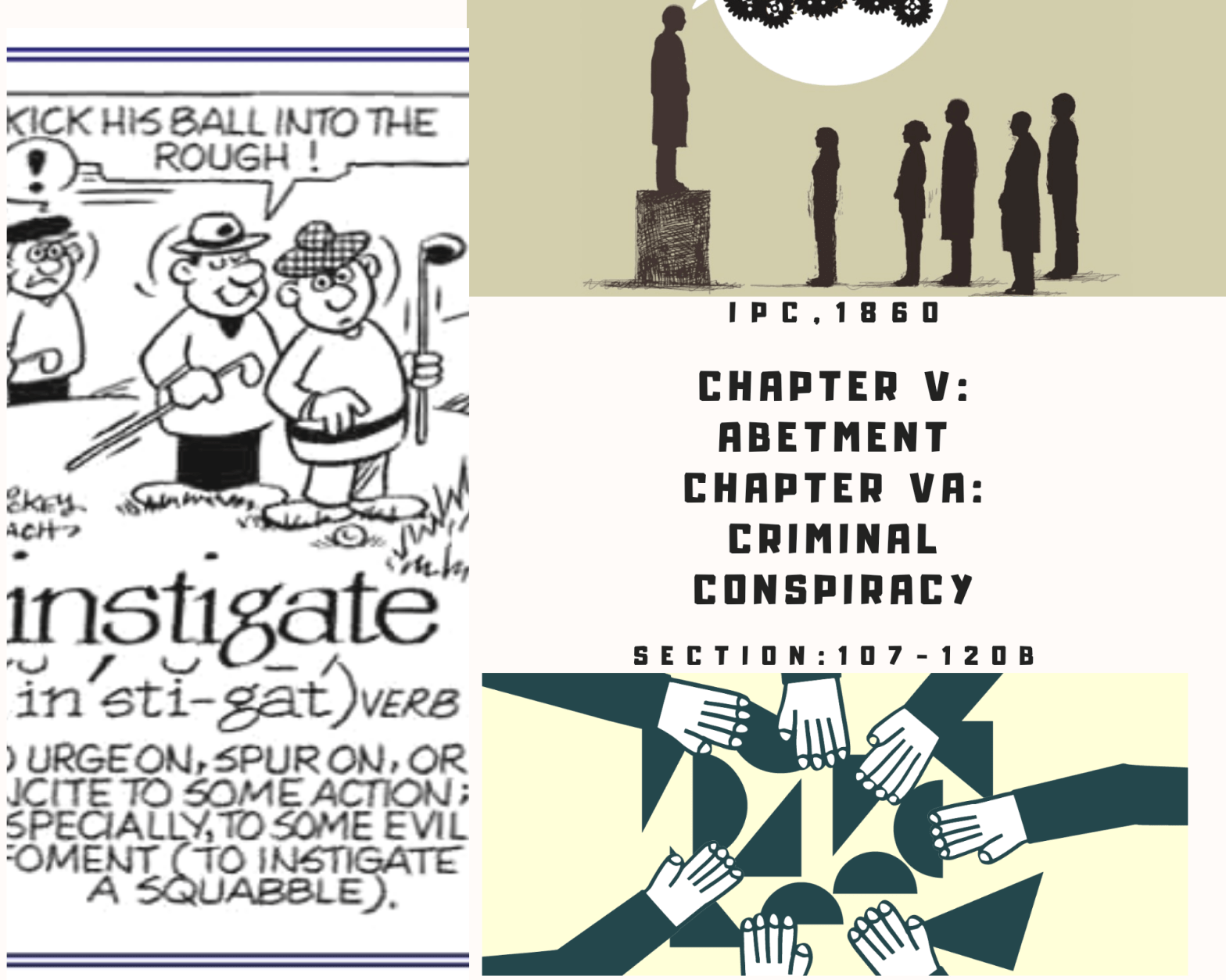
CHAPTER V: ABETMENT
SECTION 107: ABETMENT OF A THING
A person has done abetment of a thing (or abets the doing of a thing), who-
I.Instigates, any person to do that thing or
II. Engages with one or more person or persons in any conspiracy an act or illegal omission takes place in pursuance of that conspiracy or
III.Intentionally aids the doing of that thing, by an act or illegal omission.
Explanation 1: a person is said to instigate, the doing of that thing by-
- Willful misrepresentation or
- Willful concealment of material fact, which he is bound to disclose or
- Voluntarily causes or attempts to cause or procures a thing to be done.
Illustration:
- A, a public officer, authorized (by the warrant of court of justice), to apprehend Z,
- B, knowingly willfully misrepresents C as Z to the public officer,
- Here, B abets by instigating to apprehend C.
Explanation 2: A person is said to aid the doing of the act, which facilitates the commission of the act-
- Either prior to such commission or
- At the time of such commission.
SECTION 108: ABETTOR
A person abets on offence, through-
The commission of:
- An offence or
- An act which would be an offence and
With the same intention or knowledge as that of the abettor (by the person capable by, law of committing an offence).
Explanation 1: An act to amount abetment of illegal omission, an offence it is not necessary for the abettor himself to do it.
Explanation 2: it is necessary, to constitute the offence of abetment, that-
- The act abetted, should be committed or
- There should be effect of the offence caused.
Illustration: A, instigates B to murder C, A will be guilty of abetting B to commit murder, in both following circumstances:
- Either B refuses to do so or
- B in pursuance of the instigation stabs C.
Explanation 3: The abetted person, should not be necessarily-
- Capable by law of committing an offence, or
- Have same guilty intention or knowledge, as that of that of the abettor or
- Have any guilty intention or knowledge.
Illustrations:
Situation 1- Abetted is a child or lunatic:
- A, with guilty intention abets a child or a lunatic to commit an act which would be an offence,
- If committed by a person, capable by law of committing an offence and having same intention as A,
- A, whether committed the act or not, is guilty of abetting an offence.
Situation 2- Abetted is under 7 years of age:
- A, intentionally to murder Z, instigates B, child under 7 years of age to cause Z death,
- As consequence of abetment B caused Z death, in abetment of A,
- B, being incapable by law of committing an offence, committed murder and subject to punishment of death and A will be liable to be punished, in the same manner as if B had been capable by the law of committing an offence.
Situation 3- Abetted is of unsound mind:
- A instigates B, to set fire to a dwelling house,
- B being of unsound mind (unknown of the nature of the act, what could be wrong or contrary law), in consequence of abetment set a fire to the house,
- B has not committed an offence but A is guilty of abetting the offence of setting dwelling house on fire and thus liable to the punishment for that offence.
Situation 4- Abetted is under misconception:
- A induces B to believe that the property under Z’s possession belongs to him (A) and in instigates B to cause theft of that property,
- S a consequence of abetment, B believing that property to be A’s, takes it from Z’s possession in good faith,
- B, being under misconception does not taken it dishonestly, does not commit theft. But A stands guilty of abetting theft, liable to the same punishment as if B has committed theft.
Explanation 4: where, abetment of an offence, abetment of such an abetment is also an offence.
Explanation 5: For the commission of the offence of abetment by conspiracy, for abettor-
- It is not necessary to concern the offence with the person, who commits it,
- His engagement in the conspiracy, pursuance of which committed the offence, is sufficient.
Illustration:
- A, concerts with B a plan to poison Z. A agrees to administer the poison and B approaches C to procure poison, mentioning him that the third party is to administer the poison, but without mentioning A’ name,
- Where C agreeing, procured the poison and delivered it to B, A administered the poison and Z died in the consequence,
- Though A and C, had not conspired together, yet C has been engaged in the conspiracy, in pursuance of which Z has been murdered,
- Therefore, C has committed offence, under this section and is liable to the punishment for murder.
SECTION 108A: ABETMENT IN INDIA OF OFFENCES OUTSIDE INDIA
Abettor would be considered guilty of said offence:
- being in India,
- abets another person, not belonging to India,
- to commit the offence of abetment in India.
Illustration:
- A, instigates B in India (Goa),
- B (foreigner), as consequence of abetment, committed murder in Goa,
- A is guilty of abetting murder.
SECTION 109: PUNISHMENT OF ABETMENT IF THE ACT ABETTED IS COMMITTED IN CONSEQUENCE AND WHERE NO EXPRESS PROVISION IS MADE FOR ITS PUNISHMENT
Whoever abets any offence, and in consequence of abetment abetted commits that act, he will be punished by the punishment made by this code-
- Expressed punishment provision of such abetment,
- The punishment provided for the offence (if expressed punishment provision of such abetment is not mentioned).
Explanation: An act or offence is said to be committed in consequence of abetment, when it committed inn consequence of-
- The investigation or
- The pursuance of the conspiracy or
- With the aid which constitutes the abetment.
(Classified under Cr.P.C:
- Schedule 1: Punishment, cognizance, bail and triable by; same as offence
- Section 302: Compoundable offences- this offence is not listed under this section.)
Illustrations:
Situation 1: when punishment of a abetment of the offence committed is mentioned in this code-
- A offers bribe to B, a public servant as a reward for showing some of his official functions to A,
- B accepts the bribe,
- A has abetted the offence, defined under section 161.
Situation 2: when punishment of abetment of the offence committed is not mentioned in this code-
Example1-
- A instigates B, to give false evidence,
- B in consequence of investigation, commits that offence,
- A is guilty of abetting that offence and is liable to the same punishment as B.
Example2-
- A and B conspire to poison Z.
- A in pursuance of conspiracy, procures the poison and delivered it to B in order that he may administer it to Z,
- B in pursuance of conspiracy, administered the poison to Z, in A’s absence, thereby causing Z’s death,
- Thus B is guilty of murder. A is guilty of abetting that offence by conspiracy and is liable to the punishment of murder.
SECTION 110: PUNISHMENT OF ABETMENT IF PERSON ABETTED DOES ACT WITH DIFFERENT INTENTION FROM THAT OF ABETTOR
Situation: If the person abetted does the act with different intention from that of abettor
Punishment of abettor:
- Punishment, provided for the offence when would have been committed if the act had been done with the intention or knowledge of the abettor,
- With no other punishment, else than the above mentioned.
(Classified under Cr.P.C:
- Schedule 1: Punishment, cognizance, bail and triable by; same as offence
- Section 302: Compoundable offences- this offence is not listed under this section.)
SECTION 111: LIABILITY OF ABETTOR WHEN ONE ACT ABETTED AND DIFFERENT ACT DONE
Situation: When an act done is different from the act which has been abetted.
Abettor’s liability, for the act done: liability for the act, he had directly abetted-
- In the same manner and
- To the same extent.
(Classified under Cr.P.C:
- Schedule 1: Punishment, cognizance, bail and triable by; same as offence
- Section 302: Compoundable offences- this offence is not listed under this section.)
Provided (condition): The act must be a probable consequence of abatement and must have been committed under-
- The influence of the instigation or
- With the aid or
- In pursuance of the conspiracy, which constituted the abetment.
Illustration-
Example 1:
- A instigates a child to put poison into Z’s food, and gives him poison for that purpose.
- The child, in consequence of the instigation, by mistake puts the poison into the food of Y, which is by the side of that of Z.
- Here, A is liable in the same manner and to the same extent as if he had instigated the child to put the poison into the food by Y, if:
- The child was acting under the influence of A’s instigation, and
- The act done was under the circumstances a probable consequence of the abetment.
Example2:
- A instigates B to burn Z’s house.
- B sets fire to the house and at the same time commits theft of property there.
- A, though guilty of abetting the burning of the house, is not guilty of abetting the theft, for:
- The theft was a distinct act, and
- Not a probable consequence of the burning.
Example3:
- A instigates B and C to break into an inhabited house, and being resisted by Z, one of the inmates, murder Z.
- Here, A is liable to the punishment provided for murder, if that murder was the probable consequence of the abetment.
SECTION 112: ABETTOR WHEN LIABLE TO CUMULATIVE PUNISHMENT FOR ACT ABETTED AND FOR ACT DONE
Situation: If the for which the abettor is liable under section 111 is committed in addition to the act abetted.
Abettor’s liability: Cumulative punishment, for each of the offences, for-
- The act done and
- The act abetted.
Illustration-
- A instigates B to resist by force a distress made by a public servant.
- B, in consequence, resists that distress. In offering the resistance, B voluntarily causes grievous hurt to the officer executing the distress. As B has committed both the offence of resisting the distress, and the offence of voluntarily causing grievous hurt,
- B is liable to punishment for both these offences, and if A knew that B was likely voluntarily to cause grievous hurt in resisting the distress A will also be liable to punishment for each of the offences.
SECTION 113: LIABILITY OF ABETTOR FOR AN EFFECT CAUSED BY THE ACT ABETTED DIFFERENT FROM THAT INTENDED BY THE ABETTOR
Situation: An act was abetted, with an intention an abettor’s part of causing particular effect, but caused a different effect from what was intended by the abettor.
Abettor’s liability, for the act done: Effect caused, as if he had abetted the act with intention of causing that effect-
- In the same manner and
- To the same extent.
Provided: Abettor knew that the act abetted was likely to cause that effect.
(Classified under Cr.P.C:
- Schedule 1: Punishment, cognizance, bail and triable by; same as offence
- Section 302: Compoundable offences- this offence not listed under this section.)
Illustration:
- A instigates B to cause grievous hurt to Z.
- Here, if A knew that the grievous hurt abetted was likely to accuse death, A is liable to be punished with the punishment provided for murder.
SECTION 114: ABETTOR PRESENT WHEN OFFENCE IS COMMITTED
Situation: Any person who if absent would be liable to be punished as abettor, is present when the act or offence is committed.
Abettor’s liability: Punishment in consequence of the abetment, pursuance of which offence was committed.
(Classified under Cr.P.C:
- Schedule 1: Punishment, cognizance, bail and triable by; same as offence
- Section 302: Compoundable offences- this offence not listed under this section.)
SECTION 115: ABETMENT OF OFFENCE PUNISHABLE WITH DEATH OR IMPRISONMENT FOR LIFE
Punishment of abettor, who abets the commission of an offence which is punishable with death or imprisonment for life, will be in regard to-
- If offence is not committed, in consequence of the abetment and no express provision for punishment of such abetment is even made by this Code-
- Imprisonment, which may extend to 7 years and
- Fine
(Classified under Cr.P.C:
- Schedule 1: Cognizance and triable by; same as offence but bail is no- bailable
- Section 302: Compoundable offences- this offence not listed under this section.)
- If the abettor is liable in consequence of the abetment and done in consequence of abetment causes harm-
- Imprisonment, which may extend to 14 years and
- Fine
(Classified under Cr.P.C:
- Schedule 1: Cognizance and triable by; same as offence but bail is non- bailable
- Section 302: Compoundable offences- this offence not listed under this section.)
Illustration-
- A instigates B to murder Z, the offence is committed.
- If B had murdered Z, he would have been subject to the punishment of death or imprisonment for life.
- Therefore, A is liable to imprisonment for a term which may extend to seven years and also to a fine, and if any hurt be done to Z in consequence of the abetment, he will be liable to imprisonment for a term which may extend to fourteen years, and to fine.
SECTION 116: ABETMENT OF OFFENCE PUNISHABLE WITH IMPRISONMENT
- Punishment of abettor, who abets the commission of an offence which is punishable with imprisonment, will be in regard to-
- If offence, is not committed, in consequence of the abetment and no punishment of such abetment is even made by this code-
- Imprisonment, which may extend to one- forth part of the longest term provided for that offence or
- Fine, as provided for that offence or
- Both
(Classified under Cr.P.C:
- Schedule 1: Cognizance, bail and triable by; same as offence
- Section 302: Compoundable offences- this offence not listed under this section.)
- If abettor or person abetted is a public servant whose duty is to prevent, the commission of such offence-
- Imprisonment, which may extend to one- half of the longest term provided for that offence, or
- Fine, as provided for that offence or
- Both.
(Classified under Cr.P.C:
- Schedule 1: Cognizance, bail and triable by; same as offence
- Section 302: Compoundable offences- this offence not listed under this section.)
Illustration:
Example1-
- A offers a bribe to B, a public servant as a reward for showing A some favor in the exercise of B’s official functions.
- B refuses to accept the bribe.
- A is punishment under this section.
Example2-
- A instigates B to give false evidence.
- Here, if B does not give false evidence, A has nevertheless committee the offence defined in this section, and is punishable accordingly.
Example 3-
- A, a police- officer, whose duty it is to prevent robbery, abets the commission of robbery.
- Here, though the robbery be not committed, A is liable to one – half of the longest term of imprisonment provided for that offence, and also to fine.
Example 4-
- B abets the commission of a robbery by A, a police officer, whose duty it is to prevent that offence.
- Here, though robbery be not committed, B is liable to one- half of the longest term of imprisonment provided for the offence of robbery, and also to fine.
SECTION 117: ABETTING COMMISSION OF OFFENCE BY THE PUBLIC OR BY MORE THAN TEN PERSONS
Whoever abets the commission of an offence by the public generally or by any number or class of peoples exceeding ten, be punishable with-
- Imprisonment, which may extend to 3 years, or
- fine or
- Both.
(Classified under Cr.P.C:
- Schedule 1: Cognizance, bail and triable by; same as offence
- Section 302: Compoundable offences- this offence not listed under this section.)
Illustration:
- A, affixes in a public place a placard instigating a sect consisting of more than 10 members to meet at a certain time and place, with the purpose of attacking the members of an adverse sect, while engages in a procession.
- A has committed the offence defined in this section.
SECTION 118: CONCEALING DESIGN TO COMMIT OFFENCE PUNISHABLE WITH DEATH OR IMPRISONMENT FOR LIFE
Whoever intending to facilitate or knowingly that he will thereby facilitate the commission of an offence punishable with death or imprisonment
Modes of concealment-
- Voluntarily conceals , the existence of a design to commit such offence by:
- any act or
- illegal omission or
- the use of encryption or
- any other information hiding tool or
- Make any representation which he knows to be false respecting such design.
Punishment-
- Punishment, if offence is committed-
- Imprisonment, which may extend to 7 years and
- Fine
(Classified under Cr.P.C:
- Schedule 1: Cognizance and triable by; same as offence but bail is non- bailable
- Section 302: Compoundable offences- this offence not listed under this section.)
- Punishment, if offence is not committed-
- Imprisonment, which may extend to 3 years and
- Fine
(Classified under Cr.P.C:
- Schedule 1: Cognizance and triable by; same as offence but bail is bailable
- Section 302: Compoundable offences- this offence not listed under this section.)
Illustration
- A, knowing that dacoity is about to be committed at B, falsely informs the Magistrate that a dacoity is about to be committed at C, a place in an opposite direction,
- Thereby mislead the Magistrate, with intent to facilitate the commission of the offence. The dacoity is committed at B in pursuance of the design.
- A is punishable under this section.
SECTION 119: PUBLIC SERVANT CONCEALING DESIGN TO COMMIT OFFENCE WHICH IT IS HIS DUTY TO PREVENT
Whoever, being public servant intending to facilitate or knowing it to be likely that he will thereby facilitate the commission of n offence which it is his duty as such public servant to prevent.
Modes of concealment-
- Voluntarily conceals, the existence of a design to commit such offence by:
- any act or
- illegal omission, , or
- Make any representation which he knows to be false respecting such design.
Punishment-
- Punishment, if offence be committed-
- Imprisonment, which may extend to one- half of the longest term of such imprisonment or
- Fine for that offence or
- Both
(Classified under Cr.P.C:
- Schedule 1: Cognizance and triable by; same as offence
- section 302: Compoundable offences- this offence not listed under this section.)
- Punishment, if offence be punishable with death, etc-
- Imprisonment, which may extend to 10 years
(Classified under Cr.P.C:
- Schedule 1: Cognizance and triable by; same as offence but bail is non- bailable
- Section 302: Compoundable offences- this offence not listed under this section.)
- Punishment, if offence be not committed-
- Imprisonment, which may extend to one- fourth part of the longest term of such imprisonment or
- Fine for such offence or
- Both
(Classified under Cr.P.C:
- Schedule 1: Cognizance, bail and triable by; same as offence
- Section 302: Compoundable offences- this offence not listed under this section.)
Illustration:
- A, an officer of police, being legally bound to give information of all design to commit robbery, omits to give such information, with intent to facilitate the commission of that offence.
- Here A has by an illegal omission concealed that existence of B’s design,
- Therefore, A stands liable to punishment according to the provision of this section.
SECTION 120: CONCEALING DESIGN TO COMMIT OFFENCE PUNISHABLE WITH IMPRISONMENT
Whoever, intending to facilitate or knowingly it to be likely that he will thereby facilitate the commission of an offence punishable with imprisonment,
Mode of concealment-
- Voluntarily conceals, the existence of a design to commit such offence by:
- any act or
- illegal omission, , or
- Make any representation which he knows to be false respecting such design.
Punishment-
- Punishment, if offence be committed-
- Imprisonment, which may extend to one- fourth of the longest term of such imprisonment or
- Fine for such offence or
- Both
(Classified under Cr.P.C:
- Schedule 1: Cognizance, bail and triable by; same as offence
- Section 302: Compoundable offences- this offence not listed under this section.)
- Punishment, if offence is not committed-
- Imprisonment, which may extend to one- eighth of the longest term of such imprisonment or
- Fine for such offence or
- both
(Classified under Cr.P.C:
- Schedule 1: Cognizance and triable by; same as offence but bail is bailable
- Section 302: Compoundable offences- this offence not listed under this section.)
CHAPTER VA – CRIMINAL CONSPIRACY
SECTION 120A: DEFINITION OF CRIMINAL CONSPIRACY
An act is designated as criminal conspiracy, when-
- 2 or more persons come together
- Agree to do or cause to do:
- An illegal act or
- An act which is not illegal means.
Conditions-
- Except, an agreement, to commit an offence which amounts to criminal conspiracy, shall amount to criminal conspiracy:
- Exception- some act being persuaded thereof , the agreement done by one or more parties.
Explanation-
It is immaterial whether, the illegal act is:
- The ultimate object of such agreement or
- Merely incidental to the object.
SECTION 120B: PUNISHMENT OF CRIMINAL CONSPIRACY
Punishment for committing an offence-
- Whoever is a party to criminal conspiracy:
- Death,
- Imprisonment for life or
- Rigorous imprisonment for a term of 2 years or upwards or
- Same as if he had abetted such offence (if no express provision is made in this code for punishment of such a conspiracy).
(Classified under Cr.P.C:
- Schedule 1: Cognizance, bail and triable by; same as offence
- Section 302: Compoundable offences- this offence not listed under this section.)
- Whoever is a party to a criminal conspiracy other than a criminal conspiracy, to commit an offence:
- Imprisonment, which may exceed 6 months or
- Fine or
- Both.
(Classified under Cr.P.C:
- Schedule 1: Non-Cognizable, bailable and triable by Magistrate First Class
- Section 302: Compoundable offences- this offence not listed under this section.)
ABETMENT AGAINST CRIMINAL CONSPIRACY
ABETMENT
I. An act to instigate or to provide help to do an illegal act by the person who is so instigated.
II. Abetment is not per se a substantive offence.
III. Abettor is not a principle offender.
CRIMINAL CONSPIRACY
I. An act or a planning to do an planning to do an illegal act by all the persons or any of them or by some of them.
II. It is a substantive offence by itself, and is punishable as such.
III. Each accused is a principal offender.

 Farheen Dhanjal