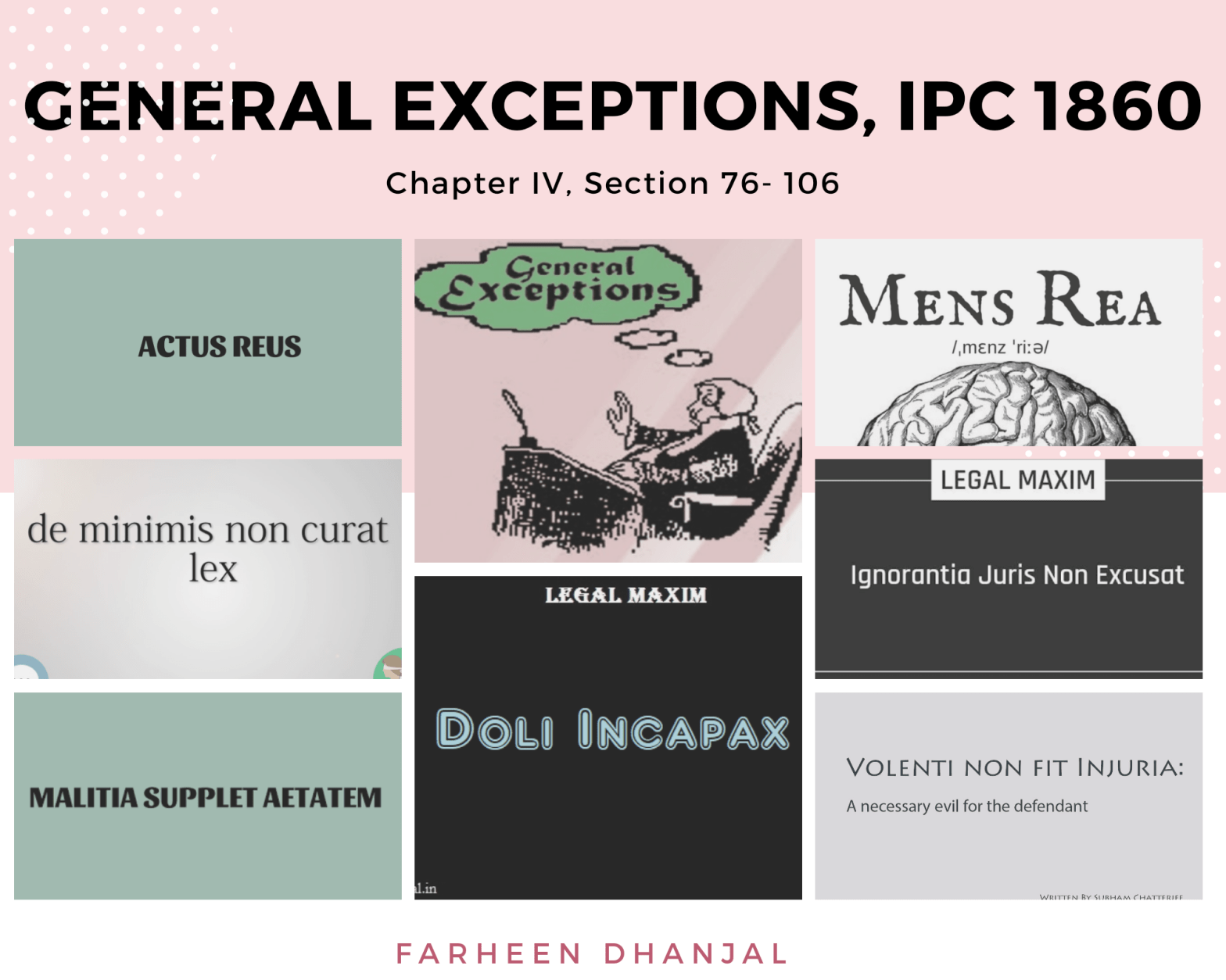
INTRODUCTION
Criminal Liability has been defined as being responsible for criminal act. It is established principle of criminal law that no one should be convicted or held liable for a crime unless some measure of subjective fault can be attributed to him. Sin que non (essential condition), to the commission of the offense, else absence of these may lead to an acquittal-
- Actus reus (active performance) and
- Mens rea (guilty intention).
The criminal law covers various punishments which vary from case to case. But it is not always necessary that a person gets punishment for a crime which he or she had committed. The Indian Penal Code, 1860 recognized defenses in Chapter IV under “General Exceptions” in section 76- 106 covers these defenses which are based on the presumption that a person is not liable for the crime committed. These defenses depend upon:
- Circumstances prevailing at the point of time,
- Mena rea(guilty mind) and
- Reasonability of action of the accused.
SECTION 6, IPC 1860:
Subject to the exceptions inculcated in the chapter titled “General Exceptions” are-
- Every definition,
- Every penal provision and
- Illustration of every definition and penal provision.
OBJECTIVES OF GENERAL EXCEPTION:
- Exceptional circumstances in which an individual can escape liability.
- Making Code construction simpler by removing the repetition of criminal exceptions.
ONUS OF PROOF:
Pre- Evidence Act, 1872-
Prosecution had to prove that the case does not fall under any exception, and was beyond reasonable doubt against the accused.
Post- Evidence Act, 1872-
Exceptions, as per section 105, Evidence Act, 1872, a claimant has to prove the existence of general exception in crimes.
CATEGORIES OF GENERAL EXCEPTIONS:
General exceptions are divided into 2 categories-
- Excusable general exceptions and
- Justifiable general exceptions
EXCUSABLE GENERAL EXCEPTIONS-
- In which though the person had caused harm, yet the person should be excused because he cannot be blamed for the act.
- Situations, covering this phenomenon-
- Mistake (section 76 and 79),
- Accident (section 81),
- Infancy (section 82 and 83),
- Insanity (section 84),
- Intoxication (section 85 and 86).
JUSTIFIABLE GENERAL EXCEPTIONS-
- In which act would have been wrongful under which the act was committed makes it tolerable and acceptable.
- Situations, covered this phenomenon-
- Judicial action (section 77 and 78),
- Consent (section 87- 92),
- Communication (section 93),
- Duress (section 94),
- Trifles (section 95) and
- Private defense (section 96- 106).
SYNOPSIS OF GENERAL EXCEPTIONS:
Any act mentioned below, is general exception to any criminal liability in existence-
- Person bound by law to do such certain.
- Judge, acting judicially.
- Committed pursuant to an order or a judgment of a Court.
- Person justified, or believed himself justified, by law.
- Caused by an accident.
- Caused to harm done without criminal intent to prevent other harm.
- Committed by child less than 7 year.
- Committed by a child above age 7 years and under 12 years, but of immature understanding.
- Committed by a person of unsound mind.
- Committed by an intoxicated person and partially exempted.
- Which is not known to be likely to cause death or grievous hurt done by consent of the sufferer.
- Not intended to cause death done by consent.
- Communication made in good faith to a person for his benefit.
- Done under threat of death.
- Causing slight harm.
- Done under private defense.
EXCUSABLE GENERAL EXCEPTION:
MISTAKE (section 76 and 77)
- If the state of things as claimed is actually true, it would justify the act done.
- Mistake must be reasonable.
- To avail this defense mistake should relate to mistake of fact not mistake of law.
IN GOOD FAITH:
- Its been defined in section 52, Indian Penal Code, 1860, applicable here.
- Done with due care and attention.
- Question is considered with reference to the position of the accused and circumstances under which he acted.
TYPES OF MISTAKES-
- Mistake of fact
- bound by law[sec. 76],
- justified by law[sec. 79]) and
- Mistake of law.
MISTAKE OF FACT
Latin maxim: ‘Ignorantia facit doth excusat’- mistake of fact is excusable.
Here, act would be considered innocent mistake if-
- Honest,
- Reasonable belief and
- True circumstance.
MISTAKE OF LAW
Latin maxim: ‘Ignorantia juris non excusat’- mistake of law is not excused.
Here, an act would be considered obligatory mistake-
- Legal presumption, everyone knows te law of the land.
- Untrue as a matter of fact.
- Needed for the purpose of expediency of law.
- Applicable even for recent statute.
- Not necessary to publish a law.
SECTION 76- ACT DONE BY PERSON BOUND, OR BY MISTAKE OF FACT BELIEVING HIMSELF BOUND, BY LAW:
An act, would no longer be an offence, if the person committing it, has committed it in –
- Mistake (of fact, not of law) and
- Good faith (considering himself to be bound by law to do it)
Illustration:
- Soldier, firing at mob on orders given by his superior officer.
- Officer of the Court of Justice, arrested someone on the order of the court, but after enquiry found that someone to be not the one, who would have been actually arrested.
SECTION 79: ACT DONE BY A PERSON JUSTIFIED, OR BY MISTAKE OF FACT BELIEVING HIMSELF, JUSTIFIED, BY LAW
An act, would no longer be an offence, if its been committed by someone, who is-
- Mistaken (of fact not of law) and
- In good faith (believes him to be justified by law)
Illustration;
A sees B, committing a murder, seizes B in (exercising his right of apprehending murderers) order to bring B before proper authorities, who later on found to be acting in self-defense.
Cases1: Chirangi V State of Nagpur (1952)
- Chirangi killed his own son my mistake thinking he was a tiger.
- He was suffering from bilateral cataract.
- Based upon evidence, he had abscess in his leg which would have produced a temperature which might have caused a temporary delirium. This could cause a secondary delusion affecting his vision.
- He was held mistaken and thus acquitted.
Case2: Waryam Singh V Emperor (1962)
- The accused mistook a human being as a ghost and killed him.
- He was not held liable under section 302, 304 0r 304A.
- Divisional Bench made it clear that ‘mens rea’ or intention to do wrong or to commit an offence did not exist and object of culpable homicide could only be a living human being.
Case3: Kiran Bedi and Ors. V Committee of Inquiry (1989)
- Petitioner refused to be deposed (testify or swear) to the beginning of the inquiry as she believed that she could depose only at the end of the inquiry.
- As the respondent i.e. the commission has not followed its own rule (by denying the treatment of the case under section- 8B of the Committee of Inquiry Act.) and has directed a wrong complaint under section 178, IPC, 1860 against the petitioners.
- It’s a unique judgment were, ‘good reputation’ is considered an element of personal security and something that is protected by the constitution, equally with the life, property and liberty.
- So, Judgment was bases upon section 79, IPC as there was ignorance (mistake) of law by the committee.
ACCIDENT (Section 80)
This exception excludes a person from criminal liability where although a person act, such act was devoid of an intention.
ABSENCE OF CRIMINAL INTENTION
- ‘Criminal intention”- Purpose or design of doing an act forbidden by criminal act without just cause or excuse.
- Act which are criminal but without the criminal intent, lacking mens rea are not penalized.
SECTION 80: ACCIDENT IN DOING A LAWFUL ACT
- An act, would obviously not be an offence if-
- Is itself lawful,
- Committed in lawful manner,
- With proper care and caution.
- Despite of fulfilling above conditions, an act could not be an offence if done by-
- Accident or misfortune and
- Without criminal intention or knowledge.
Case: State Government V Rangaswami (1952)
- An accused, who on a dark night in a cremation ground believed a man to be a ghost and inflicted injuries which cause death, was liable under section 304A, IPC, 1860.
- Divisional Bench pointed out that the accused had no reason to think that a human being would arrive on the scene at such time and place.
- Accused was acquitted on the ground of good faith.
INFANCY (Section 82 and 83)
When the child has attained maturity of understanding that he ought not o perform such an act. So, infancy is subject to exception of criminal liability.
LEGAL PRESUMPTIONS
Sec 82- Doli Incapax: A child has no discretion to distinguish right from wrong, thus criminal intention does not arise.
Example- if a child is of 7 years, pressed the trigger of the gun and caused the death of his father, and then the child will not be liable.
Sec. 83- Malitia Supplet Oetatem: Malice supplies age. If proven to have sufficient maturity of understanding, liability arises.
- Example- if a child is of 10 years, killed his father with a gun in the shadow of immaturity, he will be liable if he has not attained maturity.
SECTION 82: ACT OF A CHILD UNDER SEVEN YEARS OF AGE
An act would no longer be an offence, if committed by a child, who is under seven years of age.
SECTION 83: ACT OF A CHILD ABOVE SEVEN AND UNDER TWELVE OF IMMATURE UNDERSTANDING
An act would not be an offence, if committed by a child, who-
- Is above seven years of age and under twelve years and
- Has not attained sufficient maturity of understanding, to judge the nature and consequences of his conduct on the occasion.
Case: Krishna Bhagwan V State of Bihar (1991)
- A child stole a necklace and immediately resold it.
- His immediate act of reselling it, showed that he has attained maturity of understanding.
- Patna High Court upheld that if a child, who is accused of an offence during the trial, has attained the age 7 years or at the time of decision attained 7years of age. He will be convicted if he has the understanding and knowledge of the offence committed by him.
INSANITY (Section 84)
Person with unsound mind at the time of commission of offense, the person was incapable of knowing the nature of his acts and that his action was wrong or contrary to law, is suitable to avail the exception of insanity under this general exception.
TEST OF INSANITY-
- As the time of commission of offence
- State of mind before and after
- Only organic and natural incapability, not uncontrollable impulses, weak intellect or eccentric behavior.
SECTION 84: ACT OF A PERSON OF UNSOUND MIND
An act would no longer be an offence, if the person committing it is of:
- Unsound mind and
- Incapable of knowing the nature (wrong or contrary) to law.
Case1: McNaughton case (1843) [locus classicus]
- Where, accused killed secretary of the British Prime Minister in belief that, the Prime Minister was conspiring against him.
- He was acquitted of the charge by reason of insanity.
- This rule created presumption of sanity unless rebutted by the defense.
Case2: Madhukar G. Nigade V State of Maharashtra (2006)
Court held that the benefit of section 84 is that, at the time when the offense was committed, the accused was of-
- Unsound mind and
- unable to understand the consequences of his actions.
Case3: Ahmed V King (1949)
- Accused killed his son by thrusting a knife in his throat under the delusion and in pursuance of a command by someone in paradise, give in his dream.
- Accused was not held liable, availed the benefit of this exception.
INTOXICATION (Section 85 and 86)
Intoxication is the condition of having physical or mental control markedly diminished by the effects of alcohol or drug, and an abnormal state that is essentially a poisoning. Represented by sections 85 and 86. Main difference between them are in former accused is to be intoxicated involuntarily, in later its presumed in his knowledge until proved otherwise.
Sec. 85- An act performed without the knowledge or against the will of a person, who has is incapable of judgment due to being intoxicated.
Example- A drunk alcohol given by his friend thinking it to be a cold drink. He became intoxicated and hit a person on driving his car back home. He will not be liable as alcohol was administered to him without his will and knowledge.
Sec. 86- Offence requiring intent or knowledge, committed by an intoxicated person. It is presumed, that accused has been intoxicated knowingly unless he proves to be intoxicated without his knowledge or against his will.
Example- A person intoxicated stabs another person under influence of alcohol which was administered to him in the party against his knowledge or will, will not be liable. But if that person had stabbed that person under voluntary intoxication, then he will be liable.
SECTION 85: ACT OF A PERSON INCAPABLE OF JUDGEMENT BY REASON OF INTOXICATION CAUSED AGAINST HIS WILL
An act would not be an offence if;
- Person performing it, is intoxicated (making him incapable of knowing the nature of the act, that what is he doing is either wrong or contrary to law) and
- Administration of intoxication is-
- Without his knowledge or
- Against his will.
SECTION 86: OFFENCE REQUIRING A PARTICULAR INTENT OR KNOWLEDGE COMMITTED BY ONE WHO IS INTOXICATED
- An act would be an offence, if carried out by an intoxicated person with a particular knowledge or intent.
- Such intoxicated would be liable to be dealt with, as if he had performed such act while not been intoxicated.
- Exception here would be an unknown and unwilling intoxication.
Case1: Mirza Ghani Baig V State of Andhra Pradesh (1997)
- Voluntary dankness is not excuse for commission of a crime.
- Availed exception given under section 85.
Case2: Basdev V State of Pepsu (1956)
- The intoxicated appellant was seated next to a boy during a meal served at a wedding. He asked the boy to move a little, to so that he would occupy a more convenient seat. The boy refused, he shot him in the abdomen and killed him on the spot.
- So far as attributing knowledge is concerned, the intoxicated man is treated as if he was sober. So far as intention is concerned, it is gathered from the general circumstances of the case and the degree of intoxication.
Case3: Babau Sadashiv Jadhav case
- Accused was drunk and fought with the wife. He poured kerosene and set her on fire and stated extinguishing the fire.
- Court held that he intended to cause bodily injury which was likely to cause death.
JUSTIFIABLE GENERAL EXCEPTIONS
JUDICIAL ACTION (Section 77 and 78)
Exceptions excusing judges and its compliance with an order of the court.
Sec. 77- Act performed by the judge does not constitute an offence if he is in good faith and believes himself to be authorized while and regarding exercising his power.
Example- Giving Capital Punishment to Ajmal Kasab was done under the judicial powers of judges.
Sec. 78- Act pursuant to a judgment or order of the Court does not constitutes to eb an offence if warranted by the judgment or order of court of justice is in force, whilst proceeding is going on. It doesn’t make any difference if court later on found having no jurisdiction regarding passing of relevant judgment or order unless the one who is performing the proceedings in good faith believing the court having the jurisdiction.
Example- A judge passing an order of giving lifetime jail punishment, believing in good faith that the court has jurisdiction, will not be liable.
SECTION 77: ACT OF JUDGE WHEN ACTING JUDICIALLY:
An act, would no longer be an offence, if the person committing it is a judge, and committed it while-
- Exercising his judicial powers and
- Good faith (believing himself to be given by law)
SECTION 78: ACT DONE PURSUANT TO THE JUDGEMENT OR ORDER OF COURT:
- An act, would no longer be an offence, if such act has been committed in pursuance of (or warranted by), Court of Justice’s (despite of may not be having the jurisdiction to pass) passed-
- Judgment or
- Order.
- Such act must have been committed-
- Whilst (while), the passed judgment or order is in force (Or until it remains in force) and
- In good faith (believing the respective court of Justice having required jurisdiction).
Case: Surendra Kumar Bhatiya V Kanhaiya Lai and Others (2009)
Question was raised when the land acquisition officer passed an award under section 11(2) of the Land Acquisition Act, functions as a “judge’ as defined under section 19 of Indian Penal Code.
Court held, only judges (as defined under section 19) acting judicially are entitled to the protection under section 77 of Indian Penal Code. The Collector is neither a Judge as defined under section 19 nor does he act judicially, when discharging any of the functions under the Act.
CONSENT (Section 87- 92)
Consent means, permission for something to happen or agreement to do something. It can be denoted as assent, authority, sanction, clearance, approval as well for the same purpose.
Sec.87- an act intended or known to cause death or grievous hurt causing harm to person above 18 years on his consent to suffer.
Latin maxim: volenti non fit injuria- he who consents cannot complain.
SECTIOJN 87- ACT NOT INTENDED AND NOT KNOWN TO BE LIKELY TO CAUSE DEATH OR GREIVOUS HURT, DONE BY CONSENT
An act would no longer be an offence if there is:
- No intent to cause death or grievous hurt,
- Not known by the doer, that it could cause death or grievous hurt and
- Consent of against whom the act is committed:
- If above 18 years of age, consent (expressed or implied) is given to suffer the harm caused (eventually or with intent of the door)
- If any such person, who has given consent in good faith for someone’s benefit.
Case: Poonai Fattemah V Emperor
- Accused who professed to be a snake charmer, induced the deceased to believe him that the power to protect him from any harm caused by the snake bite.
- The deceased believed him and got bitten by the snake and died.
- The defense of consent was rejected.
Sec.88- an act done without victims consent and without intention to cause death, still performed in good faith.
SECTION 88 ACT NOT INTENDED TO CAUSEDEA5TH, DONE BY CONSENT IN GOOD FAITH FOR PERSON’S BENEFIT:
An act would no longer be an offence, if there is:
- No intent to cause death (where eventually or intentionally cause harm)
- Doer is unknown of the fact, that it could harm someone in whose benefit such act has been performed in good faith and
- Consent is given (expressed or implied) to suffer the harm or the risk of the harm.
Illustration- Surgeon, knowingly that operation could cause death, operates patient under good intention to save him.
Case: R.P Dhanda V Bhurelal
- The appellant, a medical doctor, performed an eye operation for cataract with patient’s consent.
- The operation resulted in the loss of eyesight.
- The doctor was protected under this defense as he acted in good faith.
Sec.89- act performed with the consent of guardian, for benefit of child or insane person in good faith.
SECTION 89 ACT DONE INN GOOD FAITH FOR BENEFIT OF CHILD OR INSANE PERSON, BY OR BY CONSENT OF GUARDIAN
An act would not be an offence, causing harm with intent or knowledge that was committed in-
- Good faith
- For benefit of person:
- Under 12 years of age
- Unsound mind
- By consent (expressed or implied) of:
- Guardian or
- Any other person, having lawful charge of that person.
Provided: This general exception, must not extend-
- To intentionally cause, death or attempt to cause death.
- To knowingly cause death, for any purpose other than-
- Prevention against death or grievous hurt or
- Cure against grievous hurt or infirmity.
- To voluntarily cause grievous hurt or attempt to cause grievous hurt, unless its purpose is to prevent-
- Death,
- Grievous hurt,
- Cure against any grievous disease or
- Infirmity.
- To abetment of any offence.
Sec.90- consent given in any other relevant provision of the code should not be under fear, misconception or his incapacity to give consent.
SECTION 90: CONSENT KNOWN TO BE GIVEN UNDER FEAR OR MISCONCEPTION
Concept of consent, known in any section of this Code’s intent, should not be a result of-
- Fear of injury or
- Misconception of fact or
- Person giving consent is incapable:
- Insane (of unsound mind, intoxicated), unable to understand nature and consequences of his given consent
- Child under the age of 12 years.
Illustration:
A in good faith, without his child’s consent, has his child cut for stone by surgeon knowingly that operation could cause his child’s death, but not intended to cause his death. A is within exception, as his object was to cure his child.
Case: Jakir Ali V State of Assam
- It was proved beyond doubt that the accused had sexual intercourse with the victim on a false promise of marriage.
- The Gauhati High Court held that submission of the body of by a woman under fear or misconception of fact cannot be construed as consent.
- So the conviction of the accused under section 376 and 417 of the Indian Penal Code was proper.
Sec.91- act excluded from section 87, 88, 89, which basically does not constitute any harm to the person for which consent is given. Then even, independently the act is not justified by the law even if consent is given to perform it.
SECTION 91: EXCLUSION OF ACTS WHICH ARE OFFENCES INDEPENDENTLY OF HARM CAUSE
Exceptions under section 87, 88, 89 do not extend to acts, which does not cause (intentionally or knowingly) harm to the person giving consent (himself or on someone’s behalf)
Illustration:
Causing miscarriage (unless caused in good faith for the purpose of saving life of the woman) is an offence which is not going to harm or intended to harm to the woman. Therefore, it is not an offense “by reason of harm” and consent (of woman or here guardian) does not justify the act.
Sec.92-act which is performed without consent and could cause harm is justified under some circumstances, if done in good faith.
SECTION 92: ACT DONE IN GOOD FAITH FOR BENEFIT OF A PERSON WITHOUT CONSENT
An act would not be an offence against any harm which could have been caused to a person, for whose benefit, such act is done in good faith without his consent, under circumstances where-
- It is impossible for that person to signify consent or
- If that person is incapable of giving consent or
- Has no guardian or
- A person from whom it is possible to obtain consent in time for thing to be done with benefit, in lawful charge.
Provided: This general exception, must not extend-
- To intentionally cause, death or attempt to cause death.
- To knowingly cause death, for any purpose other than-
- Prevention against death or grievous hurt or
- Cure against grievous hurt or infirmity.
- To voluntarily cause grievous hurt or attempt to cause grievous hurt, unless its purpose is to prevent-
- Death,
- Grievous hurt,
- Cure against any grievous disease or
- Infirmity.
- To abetment of any offence.
COMMUNICATION (Section 93)
Communication made in good faith, by reason of no harm to the person to whom it is made, if made for his benefit
Example- A doctor in good faith tells the wife that her husband has cancer and his life is in danger. The wife died of shock after hearing this. Doctor will not be liable because he communicated this news in good faith.
SECTION 93: COMMUNICATION MADE IN GOOD FAITH
Communication would not be an offence if-
- In good faith,
- Called cause harm to the person, to whom it is made,
- Made in benefit of that person.
Illustration
Surgeon in good faith communicates to a patient regarding his option that the patient cannot live. Patient died from shock. Surgeon committed an offence, though he knew that such communication could cause patient death.
DURESS (Section 94)
Act done under threat (coercion) or compulsion of instant death.
Example- if threatened with a dagger in hand to cause hurt to another person.
SECTION 94: ACT TO WHICH A PERSON IS COMPELLED BY THREATS
An act could not be an offence, in which the doer is compelled to do so, under threat creating apprehension that the otherwise consequences will be his own death.
Exceptions:
- Murder and
- Offences against the state punishable with death.
Provided:Doer here cannot place himself in the situation by which he may become subject to such constraint by:
- Doing it out of his own accord or
- From reasonable apprehension of harm to him, short of instant death.
Explanation 1-If a person under above mentioned threat, joins a gang of dacoits and forced-
- By threat of instant death
- To commit something unlawful.
Explanation 2-A person seized by gang of dacoits and forced-
- By threat of instant death
- To commit something unlawful.
Example- Smith compelled to take his tools and force a door of house to let dacoits enter and plunder it, it is entitled to benefit of this exception.
TRIFLES (Section 95)
Harm, caused with intention or knowledge although so slight that a person of ordinary sense and temper would not complain.
Latin maxim: ‘De minimis non curat lex’- the law takes no account of trifles.
SECTION 95: ACT CAUSING SLIGHT HARM
An act not to be an offence, if caused harm (intended or knowingly) is some slight and no person o0f ordinary sense and temper would complaint of such harm.
Case: Mrs. Veeda Menezes V Khan
- During the course of exchange of high tempers and abusive words between appellant’s husband and the respondent, the latter threw a file of papers at the former which hit the appellant causing a scratch on the elbow.
- Supreme Court held that the harm caused was slight and hence, not guilty.
PRIVATE DEFENSE (Section 96- 106)
SYNOPSIS
- Section- 96- 106: Analyze and delimit the right of private defense, come up before courts for interpretation and application frequently.
- Section- 96: general exception
- Section 97- analysis with two aspects-
- Defense of the body
- Defense of property
- Section 98 and 99- applicable upon both aspects
- Section 100, 101, 102, and 106- concerned with defense of the body
- Section 103, 104, 105- concerned with defense of property
EXPLANATION-
SECTION 96-THINGS DONE IN PRIVATE DEFENSE
Anything exercised in the name of the right of private defense is not an offence.
SECTION 97-RIGHT OF PRIVATE DEFENSE OF THE BODY AND OF PROPERTY
Defenses, exactly against what this right of private defense could be exercise, considering restrictions under section 99.
Firstly- body
- His own body- one’s own body.
- Body of any other person- anybody except our own.
Thus, any offence affecting human body- no offence stands as an exception against the human body whether one’s own or any other’s.
Secondly-Property
- Whether movable or immovable.
- Of himself or of any other person- Whether you are owner or not.
- Against any act, which is offence falling under definition of theft, robbery, mischief or criminal trespass or which is attempt to commit theft, robbery, mischief or criminal trespass- Any act (offence) namely theft, robbery, mischief and criminal trespass.
(The intent here is to cover all aggravated forms of offences named. Though, it was not necessary to particularly point words “an act which is an offence” in second clause of section 97, since section 98 is all about cases where the act is not an offence on the part of doer but the right to defend still exists).
SECTION 98-RIGHT OF PRIVATE DEFENSE AGAINST THE ACT OF A PERSON OF UNSOUND MIND, etc.
An act is certainly not an offence due to its being carried out by the youth, mature, understood person but because of its affect.
So, either it is an unsoundness of mind, intoxication or a misconception, the private defense in such condition of the doer as well.
SECTION 99- ACT AGAINST WHICH THERE IS NO RIGHT OF PRIVATE DEFENCE
Act justifies private defense-
- An act which is although not justifiable by law and here, does not reasonably cause-
- Apprehension of death or
- Grievous hurt and
- An act, what a person do or attempts to do, acting-
- In good faith and
- Under color of his office.
- What deprives private defense?
- When an act justifying private defense (above), is carried out by public servant.
- Situation, in which there is time to have recourse to the protection of the public authorities.
- What does not deprives private defense?
- When an act justifying private defense (above), is carried out on the direction of a public servant.
- When, a person who is claiming right of private defense, does not know or has no reason to believe that the person acting against whom he’s claiming his right is a public servant (explanation-1).
- When a person who is claiming right of private defense, does not know or has no reason to believe that the person acting, against whom, he’s claiming his right is being directed by a public servant (explanation-2).
- Extent to exercise right of private defense?
- Extent of mere harm inflicted (imposed), which was necessary to inflict for the defense purpose.
SECTION 100- WHEN THE RIGFHT TO PRIVATE DEFENCE OF THE BODY EXTENDS TO CAUSING DEATH-
Restrictions mentioned under section 89 regarding extent to exercise right of private defense here, of the body extends to the voluntary causing of death or of any other harm to the assailant, if exercise of any offence described hereinafter-
- Assault, reasonably cause apprehension, where consequences of such assault, otherwise have been death.
- Assault, reasonably cause apprehension, where the consequences of such assault, otherwise have been death.
- Assault, with intention of committing rape.
- Assault, with intention of gratifying unnatural lust.
- Assault, with intention of kidnapping or abduction.
- Assault, with intention of wrongfully conveying a person, under circumstances which may have reasonably caused, him to apprehend that the will be unable to have recourse to public authorities for his release.
HIGHLIGHTS:
- First, second and sixth items refer to a reasonable apprehension, as the consequence of the assault, but other 3 items refer to “assault with a particular intention”.
- Fifth item- “an assault with intention of abducting’.
- It has been held that any assault with the intention to abduct (definition under section 362) a person, is enough to attract right of Private Defense under section 100.
- Its not necessary that the abduction must itself be punishable.
- An anomaly arises, while kidnapping is an offence punishable under section 363, abduction is an auxiliary act not punishable by itself, it is an offence only when committed with one or other of the intents specified under section 364- 369.
- Hence, assault with the intention of abducting may, in some instances, is punishable only under section 352.
SECTION: 101- WHEN SUCH RIGHT EXTENDS TO CAUSING ANY HARM OTHER TYAHN DEATH.
If an offences does not comes under description of offence under section 100, but still between under section 99 (extent to exercise right of private defense, it would be then they voluntary causing to the assailant of any other than death and so fall under section 101.
SECTION 102- COMMENCEMENT AND CONTINUANCE OF THE RIGHT OF PRIVATE DEFENCE OF THE BODY-
- When does the right of private defense of the body commence?
- With the attempt or threat to commit offence arising through a reasonable apprehension of danger of the body, though the offence or may not have been committed.
- How long it continues?
- As long as the apprehension of danger to the body continues.
SECTION 103- WHEN THE RIGHT OF PRIVATE DEFENCE OF PROPERTY EXTENDS TO CAUSING DEATH
Restrictions mentioned under section 99 regarding extent to exercise right to private defense here, the property extends to the voluntary causing of death or any other harm to the assailant, if exercise of any offence described hereinafter-
- Robbery
- House-breaking of night
- Mischief by fire committed on any building tent or vessel which building tent or vessel is used as a human dwelling, or as a place for the custody of property.
- Theft, mischief or house- trespass under such circumstances as may reasonably cause apprehension that death or grievous hurt will be to consequences, if such right of private defense is not exercised.
SECTION 104- WHEN SUCH RIGHT EXTENDS TO CAUSING ANY HARM OTHER THAN DEATH
If an offence does not comes under description of offence 103, buy still be covered under section 99 (extent to exercise tight of private defense). It would be then the voluntary causing to the wrong-doer of any harm other than death.
CASE: Jai Bhagwan V. State of Haryana (1999)
Accused caused grievous hurt by dangerous weapon; he is protected as he so in exercise of right of self defense under section 104, IPC guilt cannot proved under section 326 IPC acquittal justified.
SECTION 105: COMMENCEMENT AND CONTINUENCE OF THE RIGHT OF PRIVATE DEFENCE OF PROPERTY
- When does the right of private defense of the property commence?
- With the reasonable apprehension of danger to the property commences.
- How long it continues?
- Against theft-
- Till the offender has affected his retreat with the property or
- The property has been recovered.
- Against robbery-
- As long as the offender causes or attempts to cause to any person death or hurt or wrongful restraint or
- As long as the fear of instant death or instant personal restraint continues.
- Against criminal trespass or mischief-
- As long as offender continues the commission of criminal trespass or mischief.
- Against house-breaking by night-
- As long as the house-trespass which has been began by such house-breaking continues.
SECTIONH 106: RIGHT OF PRIVATE DEFENCE AGAINST ASSAULTN THERE IS RISK OF HARM TO INNOCENT PERSON
While exercising right of private defense against an assault which reasonably causes apprehension of death, and the defender finds it impossible to exercise his right of private defense without risking harm to an innocent person in such, situation, defender’s right of private defense extends to the running of that risk.
For example-
- A got attacked by mob, who attempted to murder him,
- Effectually he cannot exercise his righty of private defense without firing on the mob,
- And he cannot fire without risk of harm to the young children, who are mingled with the mob,
- A commits no offence if by firing to harms any of the children.
CONCLUSION
These were the general exceptions which are available to the accused to escape liability or save him from the offence committed. It may extend to even causing the death of a person or harm an innocent person too, depending upon the circumstances. The accused should also have the right to be heard, keeping in view the democratic character of our nation. That’s why these exceptions are provided so as to represent oneself in the court of law.
BIBLIOGRAPHY
General Exceptions under the IPC
A Detailed Insight On The General Exceptions under Indian Penal Code (IPC)
The general exception under the Indian Penal Code by Ms. Divya D. and Mr.Pankaj Kumawat.

 Farheen Dhanjal