Before independence
When there was British colonial rule in India, death was commanded as one of the punishments in Indian Penal Code, 1860 which listed a number of capital crimes.
After independence
What was going on, remained as a practice even after independence. Nathuram Godse and Narayan Apte was the first ones to get hanged in independent India for Mahatma Gandhi’s assassination on 15th November 1949.
Significance of Punishment
To understand the vitality of punishment, it is important to understand theories of punishment given below:
- Deterrent theory
- Retributive theory
- Preventive theory
- Reformative theory
- Expiatory theory
- Multiple approach theory
I.DETERRENT THEORY:
- Deterrent means prohibited (restrain) from doing something.
- Purpose is to deter (prevent) crimes.
- It is a kind of warning to the offender so that crime could not be repeated in future.
- It sets an example for evil-minded people in the society.
- Example- mandatory license revocation for driving while intoxicated.
II.RETRIBUTIVE THEORY
- Retribution means inflicting punishment on someone as vengeance for doing wrong or criminal act.
- Purpose is to make the offender realize suffering or the pain.
- Here, it becomes necessary to inflict some pain or injury on wrongdoer in order to otherwise prevent private vengeance (revenge).
- Example- death sentence awarded to hardcore criminals.
III.PREVENTIVE THEORY
- Prevention means when an action is stopped from happening or arising.
- Purpose is to keep the offender away from the society.
- Methods adopted are imprisonment, forfeiture, death punishment.
IV.REFORMATIVE THEORY
- Reform means making changes in order to improve.
- Purpose is to reform the behavior of the criminal.
- Ideology is that no one is criminal by birth.
- Reasons behind a person indulges in criminal activities, may be social, economical and environmental circumstances.
- To make criminals competent to live in the society, it is witnessed to save them through-
- Education and training
- Psychologists and sociologists (who encourage to overcome mental stability and social inequality).
V.EXPIATORY THEORY:
- Expiatory means to clear away the record, to make it as if it never existed.
- Purpose was to forgive the offender, if he expiates or repents.
- It was based upon morals and was being practiced in ancient Indian Criminal Law.
- Example- practiced by chanting mantras, fasting or even burning oneself to death.
VI.MULTI APPROACH THEORY:
Circumstantially, where combination of theories can be applied as they are not mutually exclusive and may render complete justice.
PUNISHMENT UNDER INDIAN PENAL CODE, 1860
Provisions, to punish the criminals or wrongdoers, under section 53- 75 of Indian Penal Code, 1860.
Kinds of punishments (Section- 53)
Before 1955, IPC had 6 punishments in totality, with “transportation of life”, being on 3rd place among all the other punishments. After 1955, “transportation of life” got substituted with “imprisonment for life”. But today we are left with only 5 punishments practically .
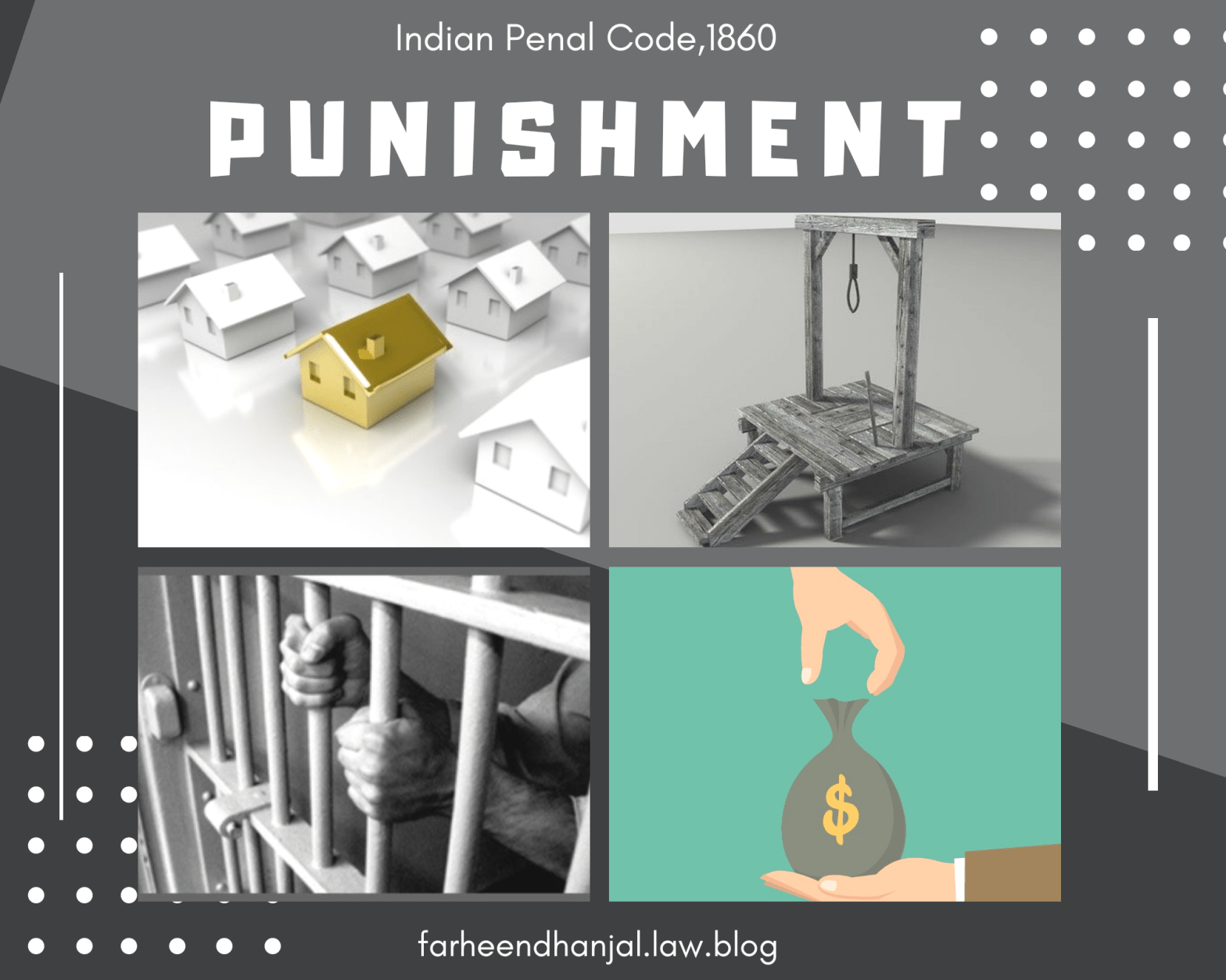
Confusion regarding number of punishments in IPC comes to an end with the clarity that, for numbering purpose there may be 6 punishments (as the numbering after removing one punishment from middle of the sequence, has not been revised) in IPC but actually there are only 5 types of punishments left in section 53 of IPC, 1860. Those 5 kinds are-
- Death sentence
- Imprisonment for life
- Imprisonment
- Forfeiture of property
- Fine
I.DEATH SENTENCE:
- Also, known as ‘capital punishment’.
- It is being sanctioned by government and ordered by court, where a person is put to death for a crime acted by him.
- In India mode of death penalty is hanging.
- Validity of death sentence was challenged with fundamental rights of the constitution and it has been a topic of debate ever since until today.
- Offences, where death penalty is given under IPC, 1860 are:
Section 115-
- Act: Abatement for an offence punishable with death or imprisonment for life (if offence is not committed).
- Applicable upon: whoever commits an offence under death or imprisonment for life.
Section 118-
- Act: concealing design to commit an offence punishable with death or imprisonment for life.
- Applicable upon: whoever voluntarily hides a wrongful act or omits wrongful commission.
Section 121-
- Act: when armed rebellion ( i.e. waging, abetting to waging of war or attempting to wage war) is made against the constitutionally and legally established government.
- Applicable upon: whoever commits offence against the state or Government.
Section 132-
- Act: uprising, supporting and encouraging formation of mutinous group of people in nation’s armed forces.
- Applicable upon: whoever initiated a revolt with group of people usually (military or crew) to oppose a particular organization.
Section 194-
- Act: With the intent to obtain a death sentence to an innocent, by presenting concocted vexatious proof.
- Applicable upon: whoever gives or fabricated false evidence which results in the death sentence of an innocent.
Section 302- causing murder of another
Section 303-
- Act: when a person murders another person.
- Applicable upon: whoever is imprisoned for life commits murder.
Section 305-
- Act: abetting suicide to an insane or minor person.
- Applicable upon: whoever drives an insane or minor person to commit suicide.
Section 364A- kidnapping
Section 376A- Rape
Section 396- Dacoity with murder.
Relevant sections to death sentence of IPC, 1860:
Section 55: commutation of sentence of death-
- Cases, in which sentence of death shall have been passed,
- Appropriate government may, without consent of offender,
- Commute punishment for any other punishment provided by this code.
Section 55A: Definition of “Appropriate Government”
- Cases, where sentence of death (or offence) against any law, related to a matter which extends to the executive power of the Union, Central Government or
- Cases, where sentence (whether of death or not), against any law, related to a matter which extends to the executive power of the Government of the State, within which the offender is sentenced.
Case law related to death sentence-
SITUATION 1: Changing constitutional validity:
Case 1: Bachan singh V State of Punjab
Supreme Court held, capital punishment shall be given in the “rarest of the rare” case. However, what constitutes the “rarest of the rare” is not prescribed by the Supreme Court or by the legislature.
[‘Rarest of the rare”-
Principle of ‘rarest of rare’ can be divided into two parts:
1.Aggravating circumstances (The judge may, on his own impose death sentence).
2.Mitigating circumstances (The Bench shall not award death penalty under rarest of the rare cases).
The judiciary of Indian is under an obligation to strike a balance between aggravating and mitigating circumstances on one hand and cry of the society on the other hand.
The Supreme Court reached its conclusion that death penalty is to be awarded only in the rarest of the rare cases and stated the following guidelines:
- The extreme penalty of death need not be inflicted except in gravest cases of extreme culpability.
- Before opting for the death penalty the circumstances of the ‘offender’ also require to be taken into consideration along with the circumstances of the ‘crime’.
- Life imprisonment is the rule and death sentence is an exception.
- A balance sheet of aggravating and mitigating circumstances has to be drawn up and in doing so the mitigating circumstances have to be accorded full weight age and just balance has to be struck between the aggravating and the mitigating circumstances, before the option is exercised.]
Case 2: Sher Singh V State of Punjab
Case 3: Triveniben V State of Gujarat
Apex court asserted affirmatively that death penalty does not invalidate rights enriched under the constitution of India.
Case 4: Jagmohan Singh V State of Uttar Pradesh
Constitutional validity of death penalty was challenged, when an argument was that the death penalty is violation of Article 14 (Right to equality), Article 19 (Right to Freedom), Article 21 (Right to Life).
Supreme Court held, death sentence is a choice between capital sentence and imprisonment of life is based on circumstances, nature and facts of the case brought during the trail.
Case 5: Mithu V State of Punjab
Supreme Court held, that mandatory death penalty is valid and unconstitutional in nature.
SITUATION 2: Case laws confirming death penalty
Case 1: State of Tamil Nadu V Nalini
- Popularly known as Rajiv Gandhi assassination case.
- In case, there were 26 accused who were from the LTTE (Liberation Tigers of Tamil Eelam) group.
- Apex court punished accused with death penalty, as they were seeking revenge for the Indian government’s decision for sending army troops in Sri Lanka.
Case 2: Jai Kumar V State of Madhya Pradesh
Supreme court held, that verdict of the sessions court and the High Court of Madhya Pradesh as it was observed that the accused murdered his sister in law and niece brutally without being in rage and admitted to crime under section 313 of Indian Penal Code, 1860.
SITUATION 3: Case laws where death sentence, commutes to life imprisonment
Case 1: Rajendra Rai V State of Bihar
- Trial court ordered death penalty, holding the accused guilty for the murder of deceased due to a dispute over the land situated between their houses and the same was confirmed by High Court.
- However, Supreme court was of the view that, case cannot be regarded under rarest o the rare category.
- Thereby, death penalty was reduced to life imprisonment.
Case 2: Sambahl Singh V State of Uttar Pradesh
- The session court held, four accused guilty for murdering three children of the Munshi Mall due to a family land dispute, where High court even confirmed the sentence.
- However, Supreme Court observed the age of four accused was not considered by lower court.
- Therefore, court reduced punishment of death penalty to life imprisonment.
II. IMPRISONMENT FOR LIFE
- Also known as transportation for life.
- It is being given for serious crimes wherein convicted remains in prison until hi r or her last breath.
- Imprisonment for life is not confirmed to 14 years of imprisonment. Although following sections indicate that only the appropriate Government can commute the sentence for imprisonment for life for a term not exceeding 14 years or released for such person unless he has served at least 14 years of imprisonment:
- Section 55, IPC- commutation of sentence of imprisonment for life.
- Section 433, CrPC- power to commute sentence
- Section 433A, CrPC- restriction on powers of remission or commutation in certain cases.
- The person is forced to spend their life in prison where they come across that, hardcore criminals which may have a bad influence to person’s better instinct.
- Feeding and housing a criminal inclusive of medical care for the remainder of life is expensive. The more criminals spend their lives in prison, the higher the expense becomes the taxpayers.
- There is an increase on the criminals who have been prescribed life sentence which forces the taxpayers to spend their hard earned money to construct additional prisons.
Relevant sections to imprisonment for life in IPC, 1860–
Section 55: Commutation of sentence of imprisonment for life
- Cases, in which sentence of imprisonment for life has been passed.
- Appropriate Government, without consent of the offender,.
- Commute punishment for imprisonment of either description for term not exceeding 14 years.
Section 55A: Definition of “Appropriate Government”
- Cases where sentence of death (or offence), against any law, which is related to a matter which extends to executive power of the Union, the Central Government and
- Cases where sentence (whether of death or not), against any law, which is related to a matter which extends to executive power of, the Government of the State within which the offender is sentenced.
Case laws related to imprisonment for life:
Case 1: Gopal Vinayak Godse V State of Maharashtra
First constitutional bench of Supreme Court, in respect of life imprisonment , held that prisoner sentenced to life imprisonment was bound to serve the remainder of his life in prison unless sentence is commuted or remitted by the appropriate government chooses to exercise its discretion to remitted by the appropriate authority. Such sentence would not be equal with a fixed term.
Case 2: Maru Ram V Union of India and Ors.
Court held, that imprisonment for life lasts breath of the prisoner and whatever the length of remissions earned, the prisoner could claim release only if the remaining sentence is remitted by the government.
Case 3: Sate of Punjab V Joginder Singh
Court held that if the sentence is “imprisonment for life”, the convict has to pass the remainder of his life under imprisonment unless of course he is granted remission by a competent authority in exercise of the powers vested in section 432, 433 of CrPC.
III. IMPRISONMENT
Imprisonment is of 2 kinds (section 60):
(i)Rigorous imprisonment
(ii)Simple imprisonment
Rigorous imprisonment:
- Given, when offence committed is of serious nature
- Prisoners are awarded with hard and congenial jobs of breaking stones, digging the earth, agriculture, carpentry, etc.
- For offences such as trespass (section 449) or giving or fabricating false evidence with intent to procure conviction of capital offence (section 194).
Simple imprisonment:
- Given, who commits lighter offences for instance wrongful restraint or defamation.
- Prisoner is awarded with (assigned) soft jobs.
- Prisoners are given work only on the basis of their request and subject to their physical fitness.
Case laws related to imprisonment:
Case 1: Santokh Singh V Izhar Husain
It was held that, test identification parade is mainly used in rape case to identify accused by the victim and if victim found lying, and giving false statement, then it is an offence under:
Section 192 – Fabricating false evidence
Section 195 – Giving or fabricating false evidence with an intent or knowledge for an offence punishment with imprisonment for 7 years or more or life imprisonment.
Case 2: Shobha Rani V The King
- In the case, landlord was accused of preventing his tenant from using the bathroom.
- By stopping the tenant from using something that he had right to use, landlord had committed wrongful restraint under section 339 (simple imprisonment for a term which may extend to one month with fine which may extend to 500 rupees or with both).
IV. FORFEITURE OF PROPERTY
Forfeiture is the loss of property, which is a consequences to default caused under contractual obligation or as a penalty for an illegal conduct.
Case laws relevant to forfeiting of property
Case 1: Kesar Devi V Union of India
In this case, it was revealed that Smt. Kesar Devi, though on ostensible owner of the properties, which are being forfeited but the real owner was her husband Jagnnath sharma.
Led to court pass a separate order against Jagannath sharma on the same date of forfeiting his two properties.
V. FINE
Court may impose a fine as an alternative for imprisonment or can impose in addition to the imprisonment.
Recent example: Due to corona virus, section 144 was imposed in Delhi March 31. The order quoted “Any individual suspected or confirmed with Covid-19 shall be measured for prevention or treatment i.e. home quarantine or institution quarantine or isolation or any such person shall cooperate to render assistance or comply with the directions of the surveillance”.
Anyone violating the order will be punished with simple imprisonment for a term which may extend to one month or with fine which may extend to Rs. 200 under section 188 of Indian Penal Code, 1860.
Relevant sections, fine in the IPC.( section 63- 70)
Section 63: Amount of fine
- Where sum is not expressed,
- Offender’s liability is unlimited, but shall not be excessive.
Section 64: Sentence of imprisonment for non-payment of fine
Cases (covered under this provision) of offences must be punishable with:
- Imprisonment as well as fine,
- Sentence of fine (with or without imprisonment),
- Only fine (imprisonment of fine).
Competent court may direct, in default of payment of the fine, imprisonment for term if:
- He may have been sentenced, in excess of other imprisonment or
- He may be liable under commutation of a sentence.
Section 65: Limit to imprisonment for non-payment of fine.
- Imprisonment is granted as default of payment of fine.
- If offence is punishable with imprisonment as well as fine, court shall not exceed one-fourth of the term of imprisonment (maximum fixed for the offence).
Section 66: Description of imprisonment for non-payment of fine.
Such imprisonment could be of any description, which is being imposed in default of payment of fine.
Section 67: Imprisonment for non-payment of fine, when offence punishable with fine only.
In such case, imprisonment term shall not exceed:
- 2 months, when fine does not exceed Rs 50.
- 4 months, when fine does not exceed Rs 100.
- 6 months, in any other case.
Section 68: Imprisonment to terminate on payment of fine.
Termination of imprisonment could be imposed against default of payment of fine:
- Either when fine is paid or
- Defaulted fine is levied by law.
Section 69: Termination on payment of proportional part of fine.
Termination of imprisonment, imposed against default of fine, when partially paid, portion will be terminated:
Not less than the portion to the part of the fine still unpaid.
Section 70: Fine leviable with 6 years or during imprisonment- Death not to discharge property from liability.
Fine or any part of fine, may be levied at any time within 6 years from sentence:
- If sentence includes imprisonment of more than 6 years, fine could be levied any time before the expiration of imprisonment period.
- After death, he still remains legally liable for debts.
SUPPLEMENTARY PROVISIONS TO PUNISHMENTS UNDER INDIAN PENAL CODE, 1860:
Section 71: Limit of punishment of offence made up of several offences
Where anything, which is an accumulation of several offences, means of its part is itself an offence, there the offender could not punished with punishment of more than 1 of such of his offence, unless otherwise expressly provided, as:
- Where, anything is an offence by falling within two or more separate definitions (as per law in force for the time being) which could be the base for defining an offence or punishing it or
- Where several acts, of which one or more than one act, by itself or themselves constitute an offence, when combined constitute a different offence.
In both of the above cases, offender should not be punished with more severe punishment than the court which tried him could award for any one of such offences.
Section 72: Punishment of person guilty of one of several offences, the judgment stating that it is doubtful of which:
- Cases, in which according to the judgment a person is guilty of several offences (being specified in the judgment).
- But, it is still doubtful, which of these offences, offender is guilty.
- Then, the offender shall be punished for offence for which the lowest punishment is provided if the same punishment is not provided for all.
SOLITARY CONFINEMENT (Section 73-75)
Section 73: solitary Confinement
- It is the isolation of a prisoner in a separate cell as a punishment.
- Its been awarded to a prisoner when he is being problematic.
- While giving solitary confinement, court shall keep in mind not to exceed 3 months in totality.
- Scale is as follows:
- If the term not exceed more than 6 months- Solitary Confinement could not exceed ( or maximum for) 1 month.
- If the term exceeds more than 6 months but not exceeds 1 year- Solitary Confinement could not exceed (or maximum for) 2 months.
- If the term exceeds 1 year- Solitary Confinement could not exceed (or maximum for) 3 months.
Section 74: Limit of Solitary confinement
- Solitary confinement should be imposed only in intervals. It shall never be for more than 14 days at a stretch.
- Interval between, the period of solitary confinement must not be less than such period of such confinements.
- In case of imprisonment of more than 3 months, solitary confinement shall not be more than 7 days in any 1 month of the total imprisonment awarded.
Case laws related to solitary confinement
Case 1: Sunil Batra V Delhi Administration
This petition was initiated by one of the prisoner’s under death sentence, when through a letter he alleged that a jail warden had brutally assaulted one of the prisoners who was in solitary confinement, for a reason to extract money.
Supreme Court held that no solitary confinement or any other type of hard labor shall be imposed without judicial appraisal of the sessions Judge.
This was the case where Supreme Court had considered the validity of solitary confinement.
Case 2: Kishore Singh Ravinder Dev V State of Rajasthan
Supreme Court held that it would be concluded to be treated with an uncivilized manner, if the prisoners are kept in separate solitary rooms for long periods ranging from 8 to 11 months, putting crossbar shackles for several days.
Section 75: Enhanced punishment for certain offences under chapter XII after previous convictions
This section says that where someone has been convicted for such an offence under chapters XII and XVII of the Code which is punishable with imprisonment of 3 years or more, and again commits such an offence under either of these chapters which is punishable with imprisonment of 3 years or more, for the second offence he shall be subject to imprisonment for life or rigorous or simple imprisonment up to 10 years.
It makes a previous convict in certain classes of case liable to enhanced sentence in every case of this description.
In Kasim Ali V Emperor, the court has pointed out the need for applying this section with some discrimination, and not in a mechanical manner.
PROMINENT PUNISHMENTS, WE HAVE NO PROVISION IN RELEVANCE
I.Community punishment:
Where, whole community was held liable against the punishment of one wrongdoer even. There is no relevant case of this punishment in India.
II.Community Service:
In Indian history, the have been only 2 judgments in its relevance-
R.K.Anand V Delhi High Court
First judgment was in which; punishment was to serve Magistrate court with free legal aid for 1 year, in cases in which the wrongdoer will be nominated by Delhi Legal Service Authority and
Fine was also imposed of Rs. 20 lacks, which Bar Council was assigned to help law colleges which could not afford to have computers and libraries.

 Farheen Dhanjal